1.3 Washed or unwashed
Washing rinses out the fines: silt, clay and rock dust finer than 0.063 mm. Some jobs need them gone. Others need them left in.
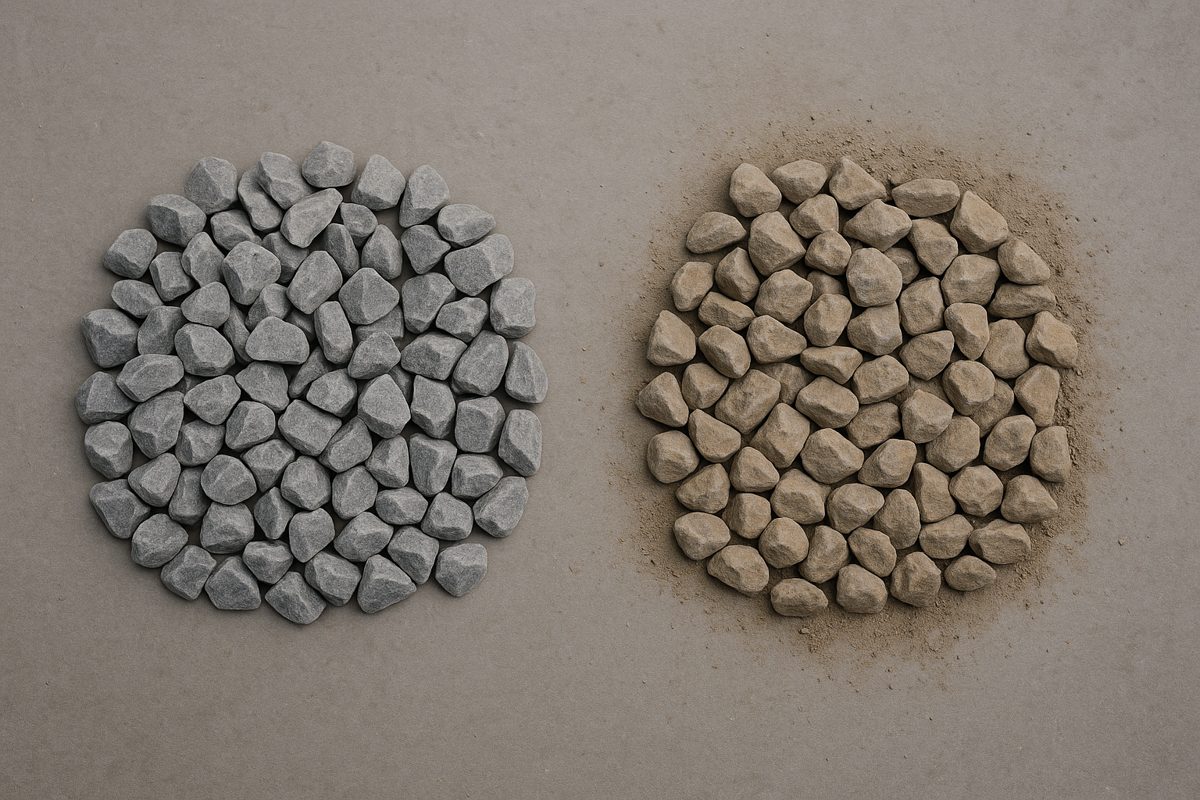
At a glance
- Washed
- Fines rinsed out. Clean grains with open gaps between them.
- Unwashed
- As dug or crushed, fines left in.
- Needs washed
- Concrete, mortar, render, screed, drainage, capillary break, permeable layers.
- Needs fines
- Bases, sub-bases, compacted gravel surfaces, structural fill.
Why it matters
Fines coat the grains and weaken the bond between cement paste and stone, and too many fines raise the water a mix needs. In drainage, fines fill the gaps that water should run through.
A base must compact into a dense, solid layer. Gravel with its crushing fines left in compacts well. Washed clean stone will not compact tightly.
How clean is clean fines by weight
| Material | Fines | Source |
|---|---|---|
| Concrete sand, floors and other wearing surfaces | at most 3 % | ASTM C33 |
| Concrete sand, other concrete | at most 5 % | ASTM C33 |
| Concrete stone | at most 1 %, or 1.5 % if free of clay | ASTM C33; EN 12620 category f1.5 or f4 |
| Drainage stone, capillary break | Washed, as little as possible | See chapter 6 |
| Bases and fill (0–16, 0–32) | Fines wanted. Each mixture has an upper limit category from 3 % to 15 % | EN 13285 |
Step by step: jar test for sand
-
1
Put 50 mm of sand in a straight-sided glass jar.
A glass jar of about one litre (one quart) works.
Sand in the jar -
2
Fill the jar with water and shake it hard.
Shake until all the sand is moving and the water is cloudy.
Shaking the jar -
3
Leave it to settle on a level surface for 4–8 hours.
The coarse sand settles first. The fines settle last and form a layer on top.
The settled jar -
4
Look at the layer on top of the sand.
One government field guide for filter sand rejects sand with more than 3 mm of fines on top of 50 mm of sand. Use the same mark as a warning sign for concrete and mortar sand, and ask for the lab fines figure if in doubt.
Arrow at the silt layer
Specifications
Harmless and harmful fines
Rock dust from crushing ("dust of fracture") does less harm than clay, which is why ASTM C33 allows more fines when they are free of clay or shale. EN 12620 treats the fines in sand as harmless when there are less than 3 % of them, or when a sand equivalent test (EN 933-8) or a methylene blue test (EN 933-9) passes.
Crushed sand
For manufactured sand whose fines are rock dust free of clay, ASTM C33 raises the sand limits from 3 % and 5 % to 5 % and 7 %.
Topsoil and roots
Organic matter such as peat, humus and organic loam delays the setting and hardening of concrete. EN 12620 refers to EN 1744-1 for the test. Keep topsoil out of the materials in this handbook.
Salt
EN 206 limits chloride as % of the cement mass: 1.0 % in concrete without steel, 0.2 % or 0.4 % in concrete with steel reinforcement, and 0.1 % or 0.2 % in prestressed concrete. Chloride in aggregate is tested to EN 1744-1.
Sources
- ASTM C33-03 Concrete aggregates: material finer than 75 µm, sand at most 3 % (abrasion) and 5 % (other), 5 % and 7 % for manufactured sand with clay-free fines; coarse aggregate 1 %, 1.5 % if free of clay or shale
- EN 12620:2002+A1:2008 Aggregates for concrete: fines = passing 0.063 mm; Table 11 categories f1,5 and f4; Annex D, when fines are non-harmful; EN 1744-1 for chloride and humus
- EN 13285 Unbound mixtures: specifications (EVS): maximum fines categories (UF), such as UF5, UF9 and UF12. See also Highway specification Series 800 (National Highways), Table 8/1: UF9 or UF12 for a 0/31,5 Type 1 sub-base, UF5 for an open-graded 0/40 mixture
- ACI Education Bulletin E1-07: dust coatings weaken bond; excess fines raise water demand; organic impurities delay setting
- Austroads AGPT04C: sand from sea shores and estuaries may be high in salt, which may cause reinforcement corrosion
- NCDOT research report 1998-06: stone dust versus active clay fines
- Silva, de Brito, Neves and Dhir (2015), Prediction of chloride ion penetration of recycled aggregate concrete, Materials Research 18(2): EN 206 chloride limits as % of cement mass, 1.0 % without steel, 0.2 % or 0.4 % with steel reinforcement, 0.1 % or 0.2 % prestressed
- Manitoba government, jar test field guide for sand: 2 in of sand in a quart jar, settle 4–8 hours, fines layer at most ⅛ in
- Washington State Department of Ecology: gravel with crushing fines compacts; washed rock "will not tightly compact"
The jar test limit comes from a guide for filter sand, not concrete sand. It is used here as a warning sign only.
GLAREUM.NET · Aggregate Handbook