7.2 Loose gravel driveway
A thin layer of clean, angular gravel spread loose on a hard, compacted base. A drive or parking area that drains, crunches underfoot and is quick to build.
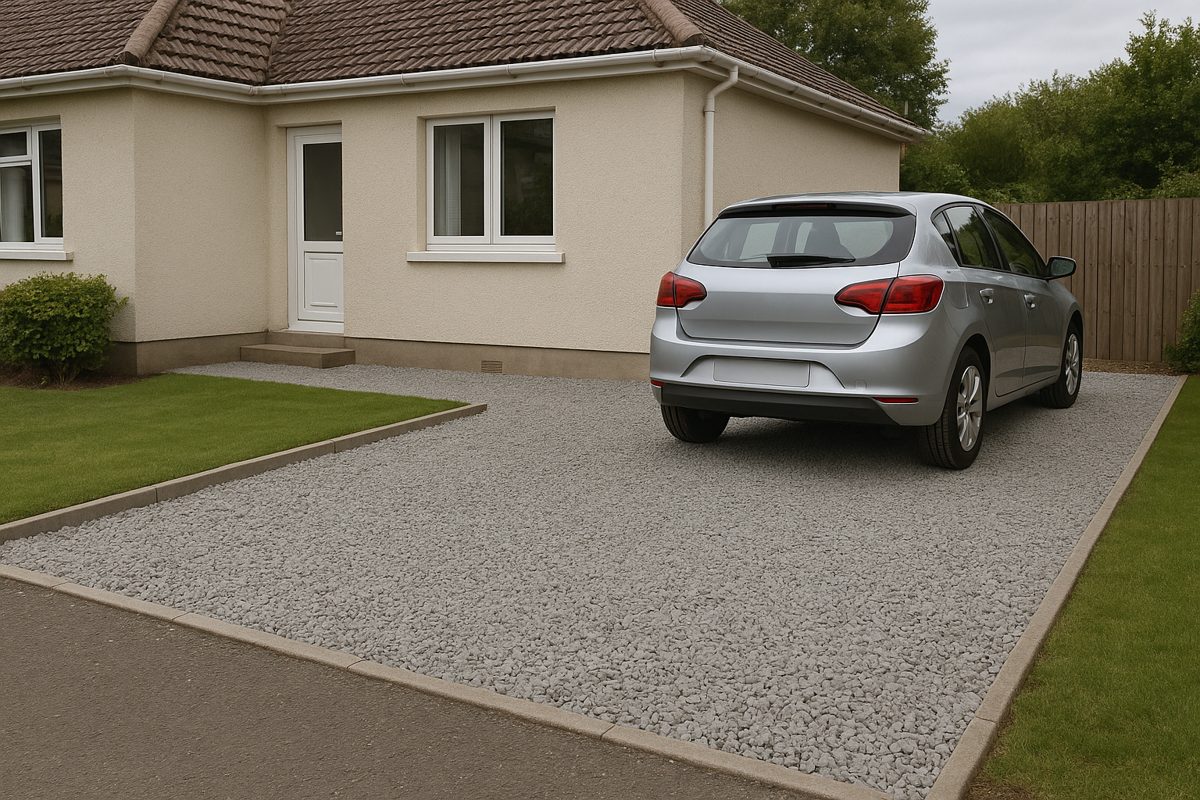
At a glance
- Difficulty
- 2 of 4
- Time
- 2–3 days for 30 m², base included
- Tools
- Spade, wheelbarrow, rake, plate compactor (for the base), string line, sharp knife for the fabric
- Parts
-
- 1 Geotextile
- 2 Base
- 3 Loose gravel
- 4 Edging and street apron
What you need per m²
| Material | Size | Type | Amount |
|---|---|---|---|
| Geotextile | – | Permeable fabric, on the soil | 1 m² + overlaps |
| Base | 0–32 mm | Crushed, with fines, 150 mm compacted (3.2) | 345 kg |
| Loose gravel | 8–16 mm | Crushed (angular), washed, no fines, about 50 mm loose | about 75 kg |
Why angular gravel?
Use this. Broken faces lock against each other, so the stones stay put under wheels and feet. Smaller stones are easier to walk on, so do not go much bigger.
Avoid it on a drive. Round stones roll against each other and never lock, so wheels dig in and feet slide. Soil-conservation guidance calls round gravel a poor choice for roads and parking areas.
Step by step
-
1
Lay a geotextile on the soil.
Spread it on the dug-out soil, under the base, and overlap the strips. It stops the base sinking into the soil and helps keep weeds down.
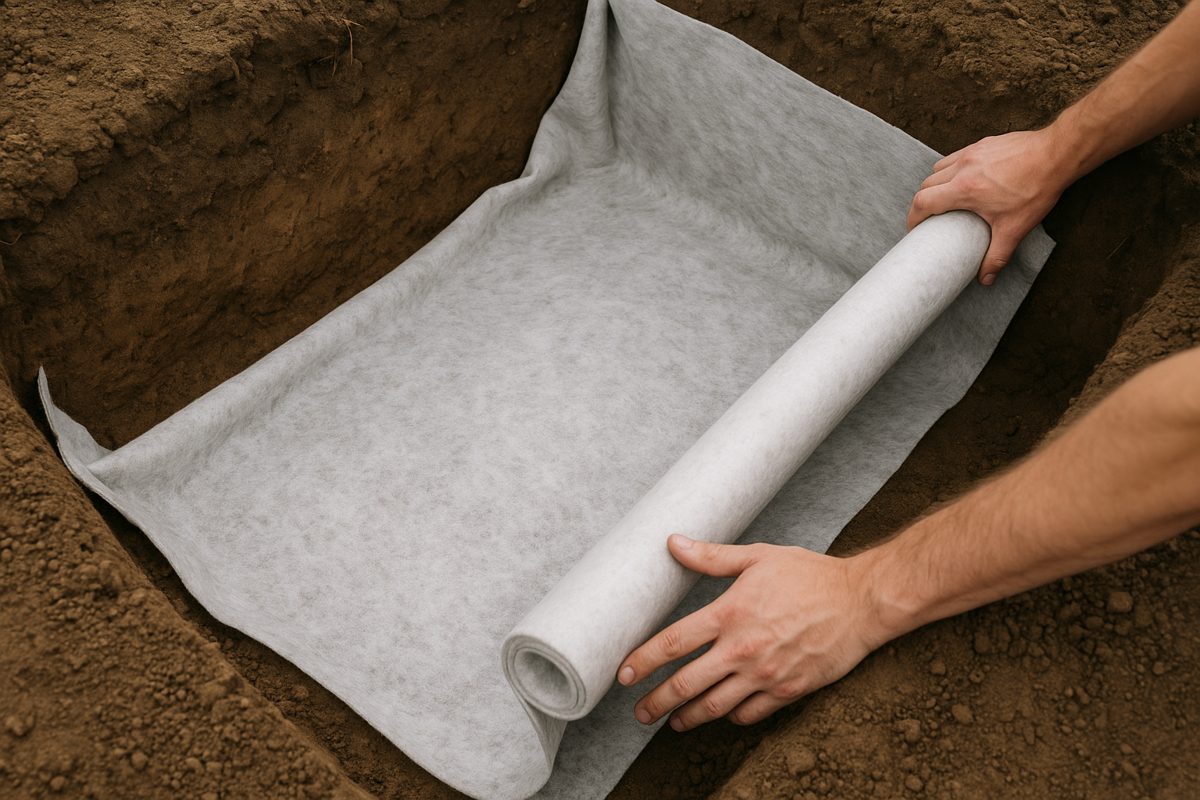
Rolling out the fabric Illustration -
2
Build the base with the fall already in it.
Follow 3.2: 150–225 mm of 0–32 crushed stone, compacted in layers, with a crossfall of about 2 %. The base takes the load. The loose gravel only wears.
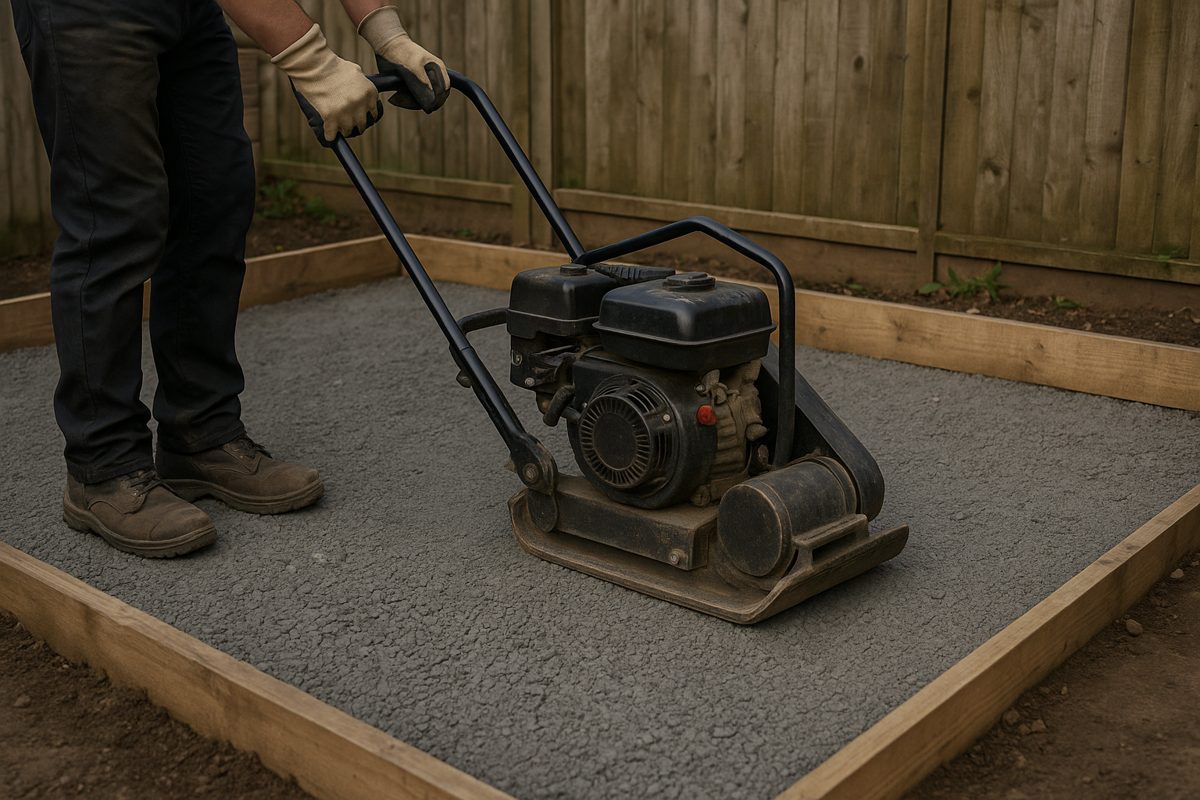
Compacting the base Illustration -
3
Fit the edging and a paved strip at the street.
Set edging along both sides (7.8). Where the drive meets the road, lay a strip of paving or asphalt. It catches the stones that tyres carry out.
The paved strip at the entrance, seen from above -
4
Spread the gravel thin.
Spread a thin layer, about 50 mm, a few stones deep. Deeper loose stone does not make the drive stronger: wheels sink in, push it into waves and throw it about.
Raking the gravel out thin -
5
Rake it even, following the fall of the base.
Keep the same thickness everywhere, so water runs off the base below and not into soft spots. Keep a few bags of the same gravel for topping up.
The finished surface, with the fall marked -
6
Rake it back and top it up as it moves.
Wheels push loose gravel to the sides and into ridges. Rake it back to the middle every so often and add thin layers where the base shows. See 7.9.
Gravel pushed to the edges, ready to rake back
Specifications
| Part | Sieve size | Thickness | How |
|---|---|---|---|
| 1 Geotextile | – | – | Permeable fabric on the soil, under the base. Overlap the strips. |
| 2 Base | 0–32 mm | 150–225 mm | As 3.2. Crossfall about 2 %. |
| 3 Loose gravel | 8–16 mm | about 50 mm | Crushed, washed, no fines. Not compacted. |
| 4 Edging, apron | – | – | Edging on both sides (7.8); paved strip at the street. |
Loose or bound
This page and 7.3 are two different surfaces. Here clean stone with no fines lies loose and lets water through. In 7.3 stone with 8–15 % fines is compacted into a hard crust. Soil-conservation guidance rates crushed rock with fines as low displacement, crushed rock without fines as moderate and rounded gravel as high, with poor traction.
Size and thickness
Use clean, angular stone of a medium size, such as 8–16 mm, in a thin layer. Garden guidance gives 50 mm as a practical minimum depth for gravel paths and notes that smaller stones are easier to walk on.
Falls
Give the base the fall (3.2: at least 2 %). Gravel-road guidance uses a crown of about 4 % (12 mm per 300 mm of width) on unpaved surfaces and never more than 6 %. UK guidance says a drive steeper than 1 in 20 may not suit a permeable surface, and loose gravel is not suitable on steep drives.
Scatter
Loose gravel scatters and forms waves. A strip of paving or asphalt at the entrance limits the loss onto the street.
Sources
- UK government (DCLG), Guidance on the permeable surfacing of front gardens: loose gravel drive is a surface layer of gravel on a sub-base; gravel scatters or forms waves, is not suitable on steeply sloping drives or for wheelchairs; a strip of block paving or asphalt at the entrance limits loss and spread; geotextile at the base of the construction stops the sub-base sinking and helps prevent weeds; a drive steeper than 1 in 20 may not suit permeable surfacing; about 150 mm of compacted sub-base
- USDA NRCS, Earth and aggregate surfacing design guide, Technical Note 210-AEN-04 (2017): round or pea gravel is a poor choice for roads and parking areas because it does not compact or interlock and rolls; Table 9 displacement low (crushed with fines), moderate (crushed without fines), high (rounded gravel); geotextile acts as a separator between subgrade and aggregate
- University of California Master Gardeners, Gravel pathways in the garden: rounded gravel never packs into a solid surface, angular stone does; smaller pieces are easier to walk on; 2 in (50 mm) is a practical minimum depth for a gravel path
- Vermont Agency of Natural Resources, Lake-friendly living: crowned driveways: crushed gravel, not round stone, for packing; crushed gravel with packing dust binds into a solid surface; crown ½ in per foot of width from the centre
- FHWA and South Dakota LTAP, Gravel roads construction and maintenance guide (2015): crown about ½ in per foot (about 4 %), never more than 6 %; some loose stone ("float") is found on the surface of virtually all gravel roads
- FHWA-HRT-15-034, open-graded aggregates: No. 57 clean stone, loosest unit weight 95.4 lb/ft³ (1.53 t/m³)
- FHWA-RD-97-148, Granular base: natural aggregates weigh about 2.0–2.3 t/m³ in place
Amounts: base 0.15 m × 2.3 t/m³ ≈ 345 kg per m², as in 3.2; loose gravel 0.05 m × 1.53 t/m³ ≈ 75 kg per m², using the loosest unit weight of No. 57 clean stone. No waste is included. The 1 in 20 limit in the UK guidance is written for permeable surfacing in general, not for loose gravel alone. 4 % ≈ ½ in per foot (about 12 mm per 300 mm).
GLAREUM.NET · Aggregate Handbook