8.1 Loose gravel path
Loose stones raked over a firm, compacted base. Cheap, quick and it lets rain through, but the stones move underfoot: not for wheelchairs, pushchairs or slopes.
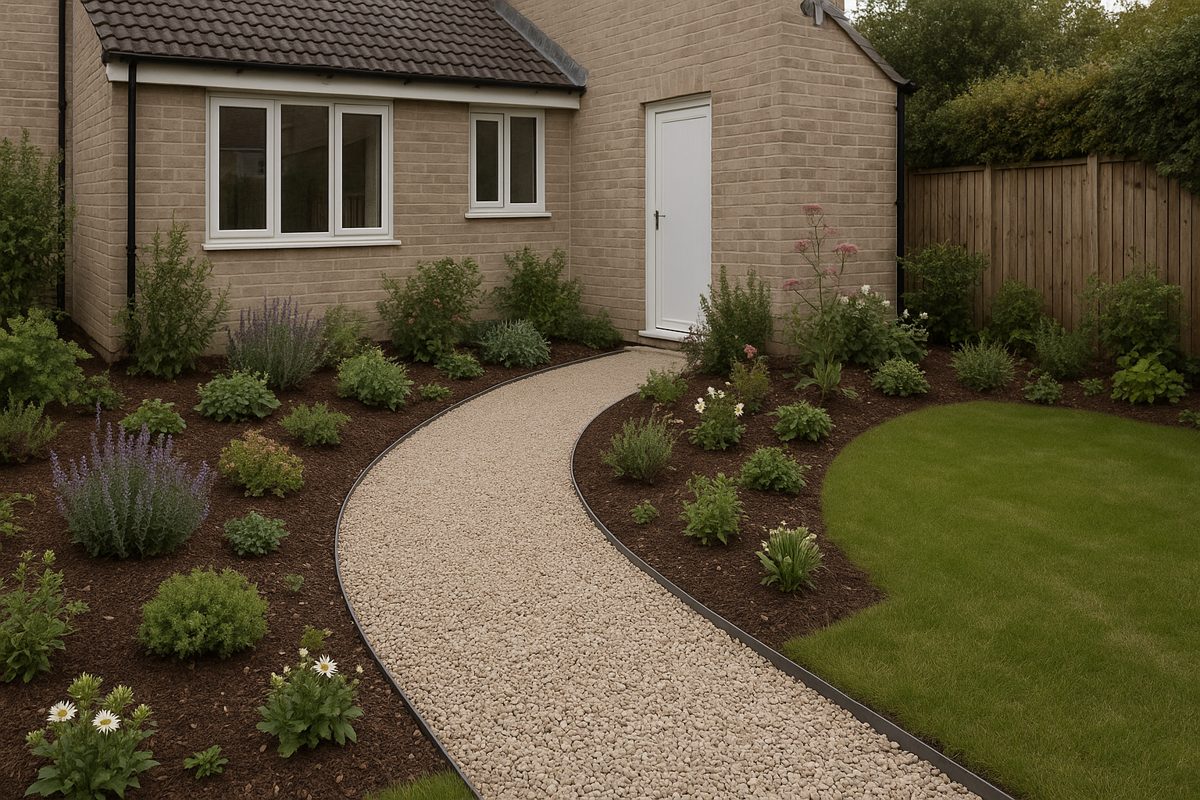
At a glance
- Difficulty
- 2 of 4
- Time
- 1 day for 10 m of path
- Tools
- Spade, wheelbarrow, rake, plate compactor or hand tamper, string line, spirit level
- Parts
-
- 1 Base
- 2 Binding layer
- 3 Loose top
What you need per m²
| Material | Size | Type | Amount |
|---|---|---|---|
| Base | 0–32 mm | Crushed, with fines, 100 mm (3.1) | 230 kg |
| Binding layer | 0–8 mm | Crushed, with fines, 40 mm | 90 kg |
| Loose top | 4–8 or 8–16 mm | Washed, crushed or rounded, one or two stones deep | 16 kg per 10 mm deep |
| Geotextile | – | Non-woven, on soft or wet ground | 1 m² + overlaps |
Why crushed or rounded on top?
Pea gravel. Soft-looking and smooth underfoot, but round stones roll on each other: they scatter, form waves and sink under a wheel. Keep it to paths you only walk on.
Angular stones lock against each other a little (1.2), so they stay put better on a gentle slope and travel less onto the lawn. Neither size makes a path firm enough for wheelchairs: for that, leave out the loose top (8.2).
Step by step
-
1
Mark out and dig out the path.
Dig to the depth of all three layers, about 140 mm plus the loose top, and a little wider than the path. Take off all topsoil. Plan for the finished top to sit just above the ground beside it, so water runs off.
The dug-out bed -
2
Set the edging.
Loose stones need a fixed edge, or they wander into the lawn and beds. Set it to the string line before the base goes in (8.5).
Edging set to the line -
3
Lay a geotextile on soft or wet ground.
If your heel sinks into the bottom of the dig, lay a non-woven geotextile over the whole bed, up the sides to the edging. It keeps the soil and the stone apart.
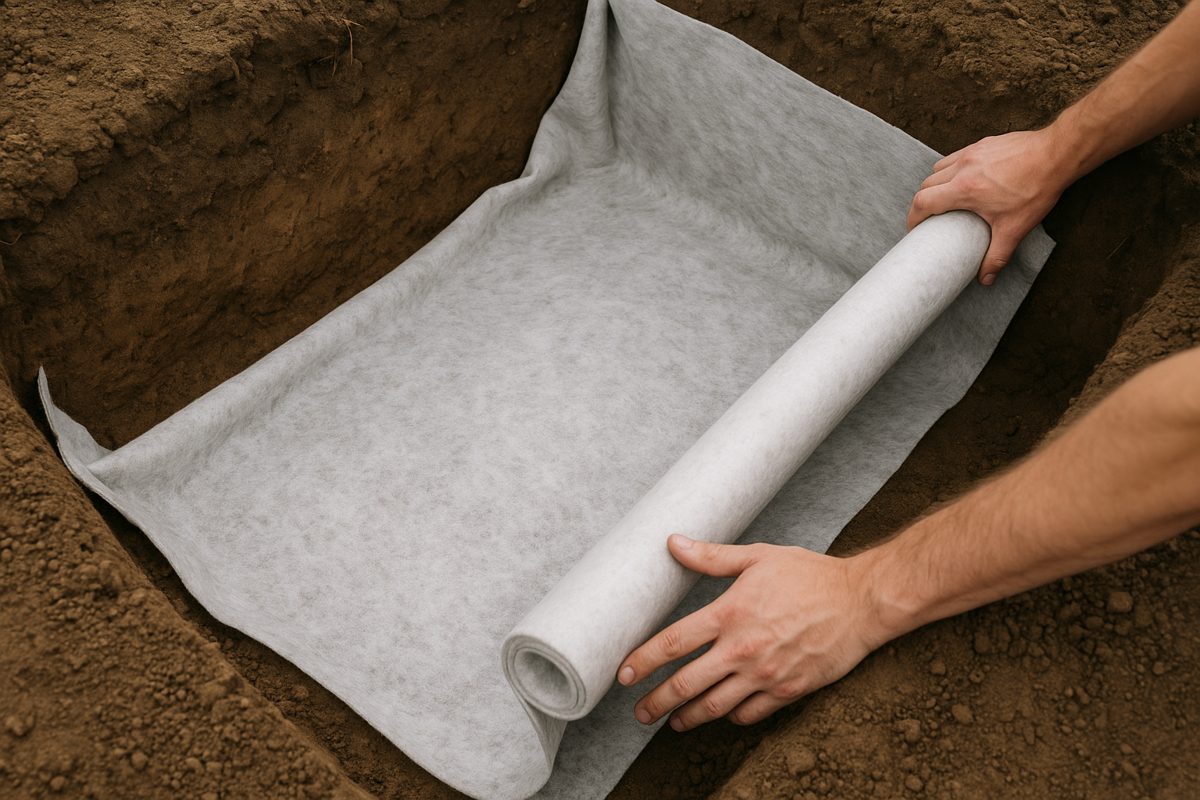
Geotextile in the bed Illustration -
4
Lay and compact the base.
Build 100 mm of 0–32 crushed stone as for a patio path (3.1), with a fall of about 2 % to one side or a slight crown.
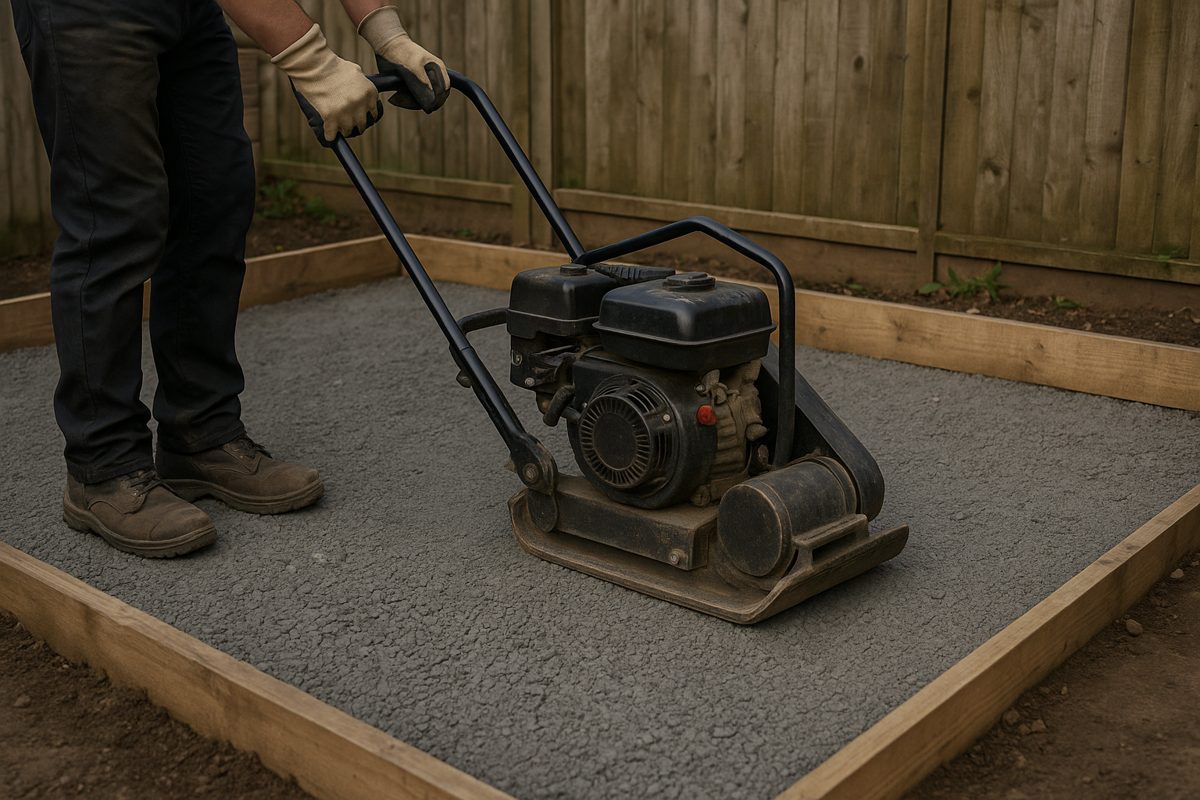
Compacting the base Illustration -
5
Add a binding layer and compact it.
Spread 30–50 mm of damp 0–8 crushed stone with fines and compact it hard. This firm layer is what you walk on; the loose stones only cover it.
The compacted binding layer -
6
Spread the loose top thinly.
Rake it out to about one or two stones deep, no more. Thick loose gravel is hard to walk on and to push a barrow through.
Raking the loose top -
7
Keep it in shape.
Rake stones back from the edges and the lawn. Top up with the same stone after a few years.
Raking back
Specifications
| Part | Sieve size | Thickness | How |
|---|---|---|---|
| 1 Base | 0–32 mm | 100 mm | Crushed with fines, compacted (3.1). Scottish path guidance: at least 100 mm. |
| 2 Binding layer | 0–8 mm | 30–50 mm | Crushed with fines, damp, compacted. Danish park guidance: 3–5 cm under loose stones. |
| 3 Loose top | 4–8 mm / 8–16 mm | 1–2 stones deep | Raked, not compacted. |
| Fall | – | about 2 % | To one side or both (crown). |
The binding layer
Danish guidance for the gravel paths of royal and public gardens describes a loose layer of small stones laid over a 3–5 cm layer of gravel or stone dust. Without a firm layer under it, loose gravel shifts down into the base and the path goes soft.
Geotextile
A US conservation standard puts a geotextile under all gravel trails and walkways. Path guidance from Scotland says light-use paths on well-drained, firm ground usually do not need one, and suggests a heel test of the ground. The geotextile separates soft soil from the stone above it.
Sources
- UK Government (MHCLG and Environment Agency), Guidance on the permeable surfacing of front gardens (2009): loose gravel is “Simple to construct and maintain” and cheap, but “Gravel will scatter or form waves”, it is “Not suitable on steeply sloping drives” and “Not suitable for wheel-chairs”; a geotextile at the base of the construction
- Danish Palaces and Properties Agency (Slots- og Ejendomsstyrelsen) with the University of Copenhagen, Opbygning af befæstelser: gravel paths in Frederiksberg Have (2003): a loose layer of small round stones over 3–5 cm of gravel or stone dust; loose material shifts and the path goes soft without a firm layer
- Scottish Government, Rural Payments and Services: New path, unbound surface (2015): “minimum 100 millimetre depth Type 1 granular sub-base, compacted / rolled”; shape the path to shed water
- University of Florida IFAS Extension, Gardening Solutions: walkways in the landscape: “Loose materials like mulch and gravel will need edging”; about 2 % slope to one side for drainage
- National Parks Board Singapore (NParks), Gardening resource library: pathways: gravel may need topping up after a few years
- USDA Forest Service, Soil stabilizers on universally accessible trails (R. Bergmann, 2000): sand and pea-size gravel are unsuitable for accessible trails; loose coarse rock makes turning a wheelchair difficult
- USDA NRCS Vermont, Conservation Practice Standard 575: Trails and walkways (2021): “A geotextile or other approved underlayment shall be designed and installed on all gravel trails and walkways”
- Paths for All and Scottish Natural Heritage, Lowland Path Construction Guide (2019): light-use paths on well-drained, reasonably hard ground usually need no geotextile; field heel test
- FHWA-RD-97-148, Granular base: natural aggregates weigh about 2.0–2.3 t/m³ in place
- Penn State University, CE 584 concrete course notes: aggregates: aggregate weighs 1,520–1,680 kg/m³
Amounts: compacted base and surface gravel at about 2.3 t per m³, the top of the 2.0–2.3 t/m³ that FHWA gives for natural aggregate in place, so they err on the generous side; loose stone and bedding sand at about 1.6 t/m³ (Penn State course notes give 1,520–1,680 kg/m³ for aggregate). No waste is included; order a little extra. The dig depth is the sum of the layers.
GLAREUM.NET · Aggregate Handbook