8.2 Self-binding gravel path
Crushed gravel with its fines and a little clay left in, laid damp and compacted until it sets firm. The classic path of palace gardens and parks, firm enough for wheelchairs.
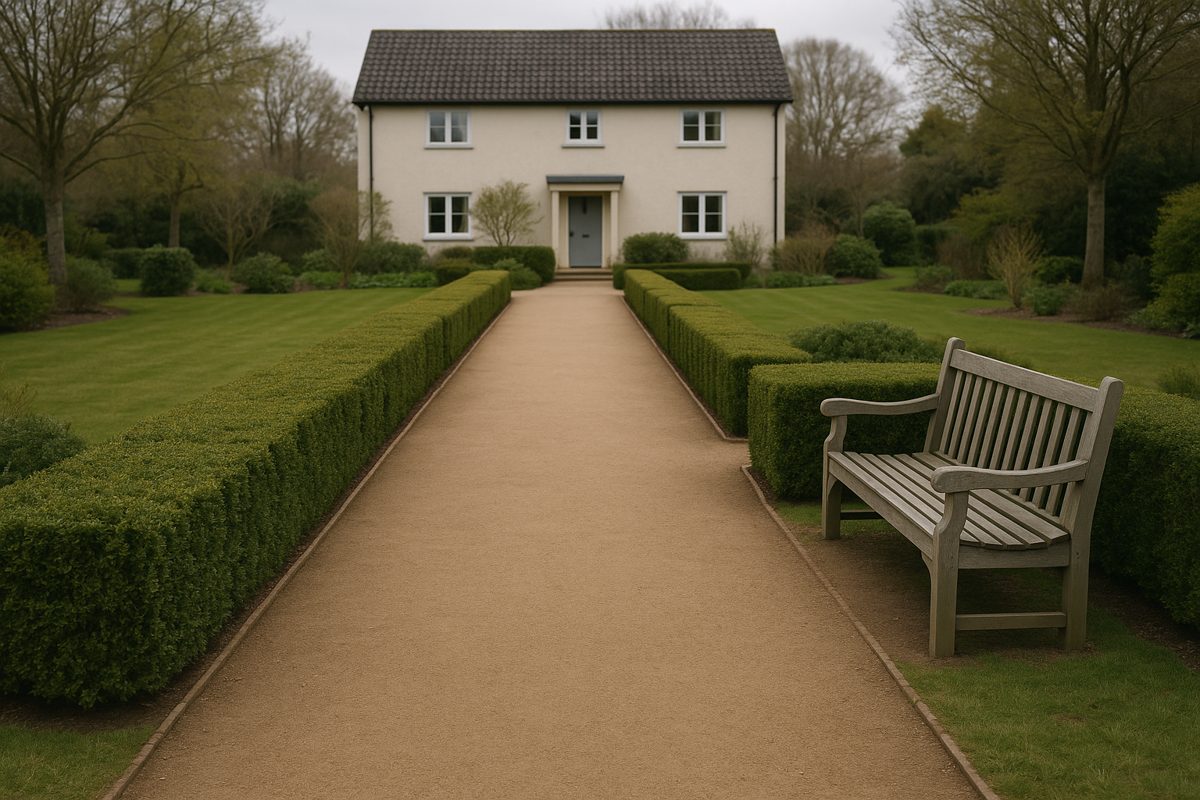
At a glance
- Difficulty
- 2 of 4
- Time
- 1–2 days for 10 m of path
- Tools
- Spade, wheelbarrow, rake, plate compactor or roller, hose with a spray nozzle, string line, 3 m straightedge
- Parts
-
- 1 Base
- 2 Bound surface
What you need per m²
| Material | Size | Type | Amount |
|---|---|---|---|
| Base | 0–32 mm | Crushed, with fines, 100 mm (3.1) | 230 kg |
| Surface | 0–8 or 0–11 mm | Self-binding: 8–12 % fines with some clay, 50 mm | 100 kg |
| Water | – | To bring it to about 9 % water | about 5 litres |
Why 50 mm on a base, or 100 mm alone?
On a crushed stone base. The usual build for a garden or park path: the base carries the load, the bound layer is the wearing surface. Danish trials used 5 cm; older Danish practice was at least 4 cm.
On its own, on firm, well-drained ground. The same gravel does both jobs. The university guidance asks for at least 5 cm and preferably 10 cm or more when it goes straight onto soil.
What makes it bind grading
Self-binding gravel is a crushed gravel that keeps its fines and a small amount of clay. Compacted damp, the fines and clay fill the gaps and glue the stones together; dry, it sets hard. Too little fine material and the surface ravels into loose stones and dust. Too much clay and it turns to mud when wet. The grading below is the one the University of Copenhagen specifies for palace and park paths in Denmark.
| Sieve, mm | Passing, % |
|---|---|
| 11.2 | 100 |
| 8 | 97–100 |
| 4 | 72–82 |
| 2 | 52–64 |
| 1 | 40–47 |
| 0.5 | 28–34 |
| 0.25 | 18–23 |
| 0.125 | 12–15 |
| 0.063 | 8–12 |
Also called hoggin or binding gravel in Britain, whin dust in Scotland, lergrus or slotsgrus in Denmark, and crusher fines in the US (8.3). The names differ; ask for the grading: a crushed 0–8 to 0–11 with fines and a little clay, not washed.
Step by step
-
1
Dig out and shape the bottom to the final fall.
Take off all topsoil. Give the bottom of the dig the same crown or side fall as the finished path, 2.5–4 %, so water that gets in can get out.
The shaped bed -
2
Make the edges.
Either let the base run wider than the surface and turf over its edge, or set a steel or plastic edge (8.5). The surface finishes level with or just above the edge, never below it.
The path edge -
3
Lay and compact the base.
100 mm of 0–32 crushed stone, compacted, as for a patio path (3.1).
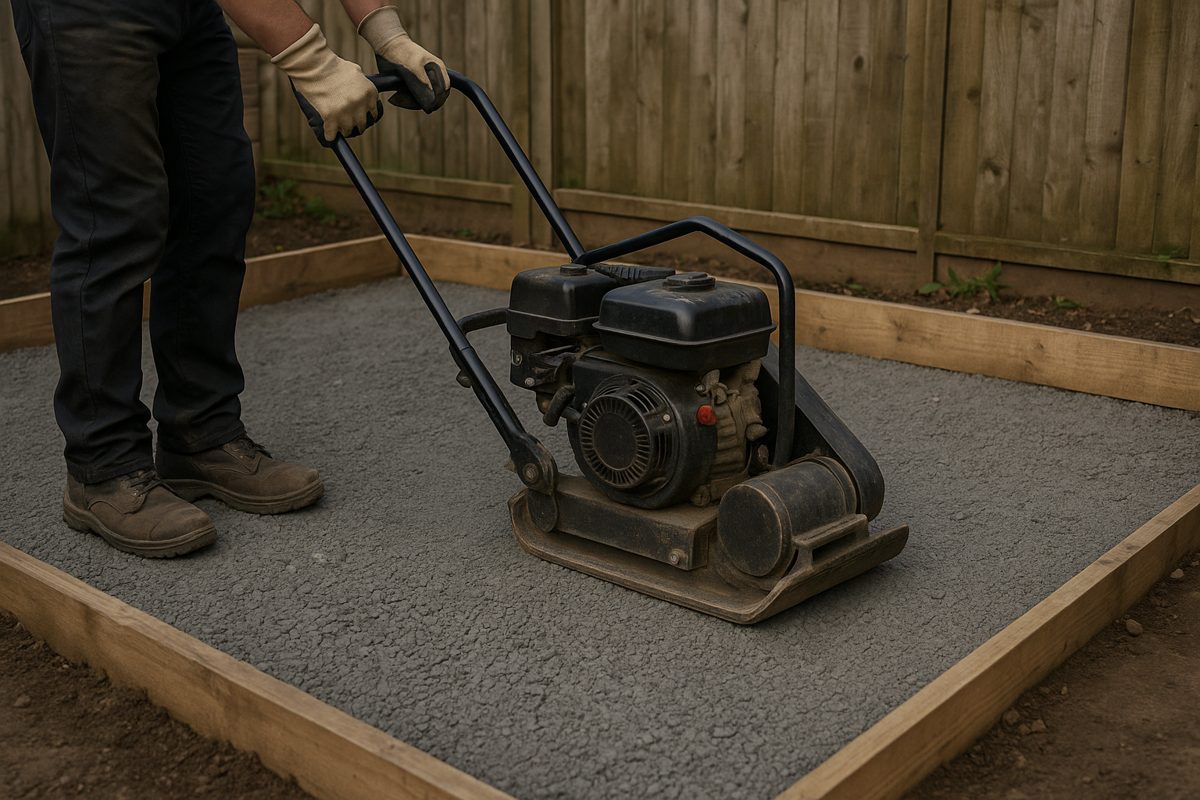
Compacting the base Illustration -
4
Wet the gravel to about 9 %.
It usually arrives too dry. Add about 1 litre of water per m² for each 5 cm of layer and each percent it is too dry, and turn it over. A squeezed handful should hold together without water running out.
A squeezed handful -
5
Spread it 20 % thicker than the finished layer.
For 50 mm finished, spread 60 mm. Rake it to the string line with the crown or fall in it.
Raking to the line -
6
Compact it hard.
A 400 kg plate compactor needs about 2 passes for a 5 cm layer and 4 for 10 cm. A light hire plate needs more. Check with a 3 m straightedge: no gap over 10 mm.
The finished crown -
7
Let it dry and set.
It binds as it dries. Keep heavy wheels off until it is hard.
The set surface -
8
Keep it in shape.
Rake off leaves; do not use a leaf blower or a suction sweeper. Fill holes with the same gravel, a little proud, and compact. Add a thin wearing layer of the same gravel when stones start to show. In winter, scrape snow and grit with 2–3 mm chippings instead of salt.
Filling a hole
Specifications
| Part | Sieve size | Thickness | How |
|---|---|---|---|
| 1 Base | 0–32 mm | 100 mm | Crushed with fines, compacted (3.1). Sustrans: 100–150 mm under self-binding surfaces. |
| 2 Surface | 0–8 mm / 0–11 mm | 50 mm | 8–12 % passing 0.063 mm, compacted damp. Spread 20 % thicker. |
| 2 Surface, no base | 0–8 mm / 0–11 mm | 100 mm | On firm, well-drained ground only. |
| 2 Whin dust (Scotland) | 4–6 mm to dust | about 25 mm | On 100 mm Type 1 (0–32). Not free-draining. |
| Fall | – | 2.5–4 % | Crown or side fall. The bottom of the dig gets the same fall. |
Fines and clay
The Copenhagen specification: 8–12 % passing 0.063 mm, of which 10–30 % is clay (finer than 0.002 mm); non-plastic; at most 20 % rounded grains. Older Danish landscape norms asked for a 0–8 clay gravel with 10–20 % under 0.075 mm, and a Norwegian study found about 12 % clay and silt ideal (7–23 %). US trail guidance asks for 6–15 % fines in crusher fines.
Water and compaction
Best water content about 9 %. Compaction to at least 95 % of the reference density (about 2.06–2.07 t/m³), no single point under 92 %. Passes for a 400 kg plate: 2 (5 cm), 4 (10 cm), 7 (15–20 cm). Spread 20 % thicker: 6 cm loose for 5 cm finished.
Falls
The Danish guidance gives 25–40 ‰ (2.5–4 %), with the subgrade shaped to the same fall. The Frederiksberg Have trial used a parabolic crown with 25 ‰ to each side, ±1 cm.
Whin dust
In Scotland the usual path surface is whin or granite dust, about 25 mm thick on the base. Whin dust is not free-draining, so frost heave and heavy rain can turn it to mush; granite dust drains better.
Sources
- University of Copenhagen, Department of Geosciences and Natural Resource Management (IGN): specification for a self-binding path gravel: grading 0–11.2 mm with 8–12 % passing 0.063 mm, clay 10–30 % of the fines, non-plastic, at most 20 % round grains; on soil at least 5 cm, preferably 10 cm or more; fall normally 25 ‰; best water content about 9 %; developed in 2002 for the paths of Frederiksberg Have
- University of Copenhagen (Skov & Landskab), construction guide for self-binding gravel (2013): spread 20 % thicker (5 cm finished → 6 cm); 1 litre of water per m² per 5 cm per percentage point; 95 % compaction, none under 92 %; passes per machine and layer; fall 25–40 ‰ with the subgrade shaped the same
- University of Copenhagen, maintenance guide for self-binding gravel (2013): rake leaves, no suction sweepers or leaf blowers; fill holes proud and recompact; add a wearing layer as needed; no salt, grit with 2–3 mm chippings; keep the surface a little higher than the ground beside it
- Danish Palaces and Properties Agency (Slots- og Ejendomsstyrelsen) with the University of Copenhagen, Opbygning af befæstelser: gravel paths in Frederiksberg Have (2003): trial surfaces 5 cm on a base, 10 cm as a single layer; historically at least 4 cm; older norm 0–8 clay gravel with 10–20 % under 0.075 mm; Norwegian ideal about 12 % clay and silt (7–23 %); parabolic crown 25 ‰; at most 10 mm under a 3 m straightedge
- Paths for All and Scottish Natural Heritage, Lowland Path Construction Guide (2019): unbound surfaces have “particle sizes range from 4mm, 5mm or 6mm to dust”; whin dust “usually about 25mm thick”; “as whin dust is not free draining, frost heave and heavy rain can turn the surface to mush”; unbound surfaces are “very susceptible to being washed out by water”; support the edges
- Scottish Government, Rural Payments and Services: New path, unbound surface (2015): 100 mm Type 1 sub-base and “25 millimetre depth whinstone or granite dust surfacing, compacted / rolled”
- Sustrans (charity), Cycle path surface options, Technical Information Note 8 (2012): hoggin is “composed of a well graded mixture of gravel, sand and clay”; self-binding surfaces need “a 100 – 150mm thick aggregate base”, are laid damp and compacted with a roller or vibrating plate, and do not work well on steep slopes
- Building crusher fines trails (L. Bachensky, USDA Forest Service, via American Trails, 2019): crusher fines with 6–15 % fines; grades above 5 % only where necessary, never over 8 %; patches from the same rock source
- FHWA-RD-97-148, Granular base: natural aggregates weigh about 2.0–2.3 t/m³ in place
Amounts: the surface at about 2.0 t/m³ (95 % of the 2.06–2.07 t/m³ reference density in the Copenhagen guidance), so 50 mm is about 100 kg per m²; the base at 2.3 t/m³ as on 7.3. The water line in What you need is for 50 mm about 5 % too dry. No waste is included; order a little extra. The University of Copenhagen owns a trade mark on one Danish product of this kind; this page uses its published grading only as a description of the material, not as a product to buy.
GLAREUM.NET · Aggregate Handbook