6.4 Drainage trench
A French drain: a trench with a perforated pipe in clean stone, wrapped in fabric. It collects water from wet ground and carries it away to an outlet or a soakaway.
At a glance
- Difficulty
- 2 of 4
- Used for
- Wet lawns and gardens, the uphill side of a building or path, collecting water from a wall drain (6.3)
- Tools
- Spade or trenching machine, string line, spirit level or laser, wheelbarrow, knife for fabric
- Parts
-
- 1 Perforated pipe
- 2 Drainage stone
- 3 Geotextile
- 4 Topsoil cap
What you need per metre of trench
| Material | Size | Type | Amount |
|---|---|---|---|
| Drainage stone | 16–32 mm | Washed, rounded or crushed | 175 kg |
| or | 4–20 mm | Washed, crushed | |
| Geotextile | – | Non-woven, about 270 g/m² (8 oz) | 1.7 m² |
| Drain pipe | – | Perforated, at least 100 mm | 1 m |
Why clean stone?
Large, clean gaps let water reach the pipe from all sides and carry it along even if the pipe silts up a little.
Without a filter, fine soil washes into the stone and the trench slowly stops working. The fabric wrap is the filter (6.6).
Step by step
-
1
Plan the route to a free outlet.
The water must go somewhere lower: a ditch, a slope where the pipe can come out in the open, or a soakaway (6.5). Mark the line with string.
String line along the route -
2
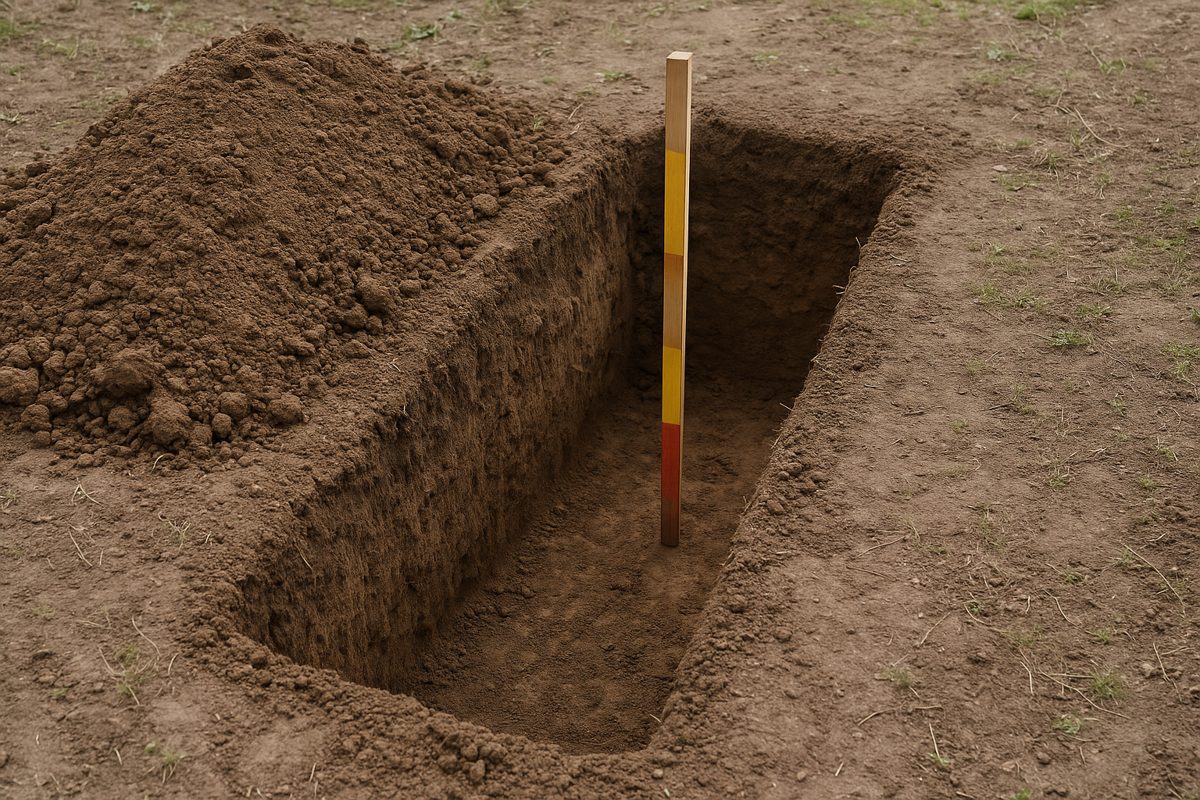
Dig the trench at least 350 mm wide and 560–600 mm deep.
Give the bottom a steady fall of 0.5–1 %, which is 5–10 mm per metre. Check with a level as you go.
The dug trench Illustration -
3
Line it with fabric and lay 100 mm of washed stone.
Leave enough fabric at the top on both sides to fold over and overlap by at least 300 mm.
Fabric lining with the first stone -
4
Lay the pipe with the holes facing down.
Water rises into the pipe from below and runs away along its bottom.
Pipe on the stone, holes down -
5
Cover the pipe with 100–150 mm of stone and fold the fabric over.
Lap one side over the other. Fill the rest, at least 230 mm, with topsoil and turf, or with more stone if the trench should also catch surface water.
Fabric folded over before the topsoil
Specifications
| Part | Size | Value | How |
|---|---|---|---|
| Trench | – | ≥ 350 mm wide, ≥ 560 mm deep | Steady fall of 0.5–1 %. |
| 1 Pipe | ≥ 100 mm | holes down | Perforated, on the bedding stone. |
| 2 Stone | 16–32 mm | 100 mm under, 100–150 mm over | Washed, clean. |
| 3 Geotextile | – | top lap ≥ 300 mm | Lines the whole trench, folded over the stone. |
| 4 Cap | – | ≥ 230 mm | Topsoil and turf, mulch or more stone. |
Stone size
The sources name clean ¾–2 in rock (19–50 mm) and crushed No. 57 stone (4.75–25 mm). 16–32 mm sits between the two, and 4–20 mm matches No. 57.
Depth
One US federal guide puts a French drain at least 18 in (450 mm) below ground, in a trench at least 22 in (560 mm) deep. Simple yard drains can be shallower, 200–600 mm, where the water is near the surface.
Sources
- US DOE Building America Solution Center (PNNL): swales, drains and site grading: “Dig trench at least 22 inches deep at minimum and 14 inches wide”; “Lay 4 inches of clean rock (¾ to 2-inch)”; “4 to 6 inches over the pipe”; “perforations down”; 8 oz fabric lapped over the top; 9 in or more of stone, topsoil or mulch on top
- Washington State University Extension: improving drainage: “the trench should be sloped between 0.5% and 1%”
- Delaware DNREC: French drain for a yard: simple yard drains are “shallow (8 to 24 inches deep)”
- Michigan DOT construction manual: underdrains: “The geotextile blanket should overlap the top of the trench a minimum of 1 foot”
- WSDOT Standard Specifications, Division 7: “the perforated pipe shall be laid with the perforations down”
- Penn State Center for Dirt and Gravel Road Studies: stone underdrains: fabric folded to a double layer on top of the drain
- Ask Extension (Cooperative Extension): French drain stone: “crushed #57 stone (about 3/4" to 1" in size)”
- Maryland Department of the Environment: stormwater materials: No. 57 stone grading, at most 5 % fines
- FHWA-HRT-15-034, open-graded aggregates: No. 57 stone loose 95.4 lb/ft³ (1.53 t/m³)
Amounts per metre: stone 0.35 m wide × 0.35 m deep (100 under, 100 pipe, 150 over) = 0.123 m³, minus the pipe (0.008 m³) ≈ 0.115 m³ × 1.53 t/m³ ≈ 175 kg, loose. Fabric: bottom, two sides and the top with a 300 mm lap ≈ 1.7 m². Order about 15 % extra stone for settling and waste (FHWA loose to dense is about 14 %).
GLAREUM.NET · Aggregate Handbook