4.4 Casting in formwork
Walls, plinths, steps and edges cast between form boards, often with steel reinforcement.
At a glance
- Difficulty
- 3 of 4
- Time (estimate)
- 1 day to build forms, 1 day to cast
- Tools
- Saw, drill, screws, form boards, braces, release oil, spirit level, mixer, tamping rod, rubber mallet
- Parts
-
- 1 Formwork
- 2 Rebar
- 3 Concrete
What you need per 0.1 m³ of concrete, about one step 1 m × 300 × 330 mm
| Material | Size | Type | Amount |
|---|---|---|---|
| Sand | 0–4 mm | Washed | 62 kg |
| Stone | 8–16 mm | Crushed or rounded | 136 kg |
| or | 4–8 mm | For thin or crowded sections | |
| Cement | – | Common cement (EN 197-1) | 29 kg |
Which stone fits? Sieve sizes are always in mm
Concrete has to flow between the form faces and between the bars. If the stone is too big it jams and leaves holes. Enter your sizes:
Step by step
-
1
Build the formwork and brace it.
Use boards or plywood screwed to stakes or studs, and brace them well. Oil the inside and wet it just before filling.
Braced form boards -
2
Fix the rebar on spacers.
Tie the bars where they cross and stand them on plastic or concrete spacers so concrete gets all round them.
Bars tied on spacers -
3
Pick the stone size.
Measure the narrowest width and the smallest clear gap between bars. Use the checker above. Most garden walls and steps take 8–16 mm.
Tape measure across the gap -
4
Mix 1 part cement, 2 parts sand, 4 parts stone.
Keep the mix stiff. Extra water makes it flow better, but it also makes it weaker and makes it shrink more.
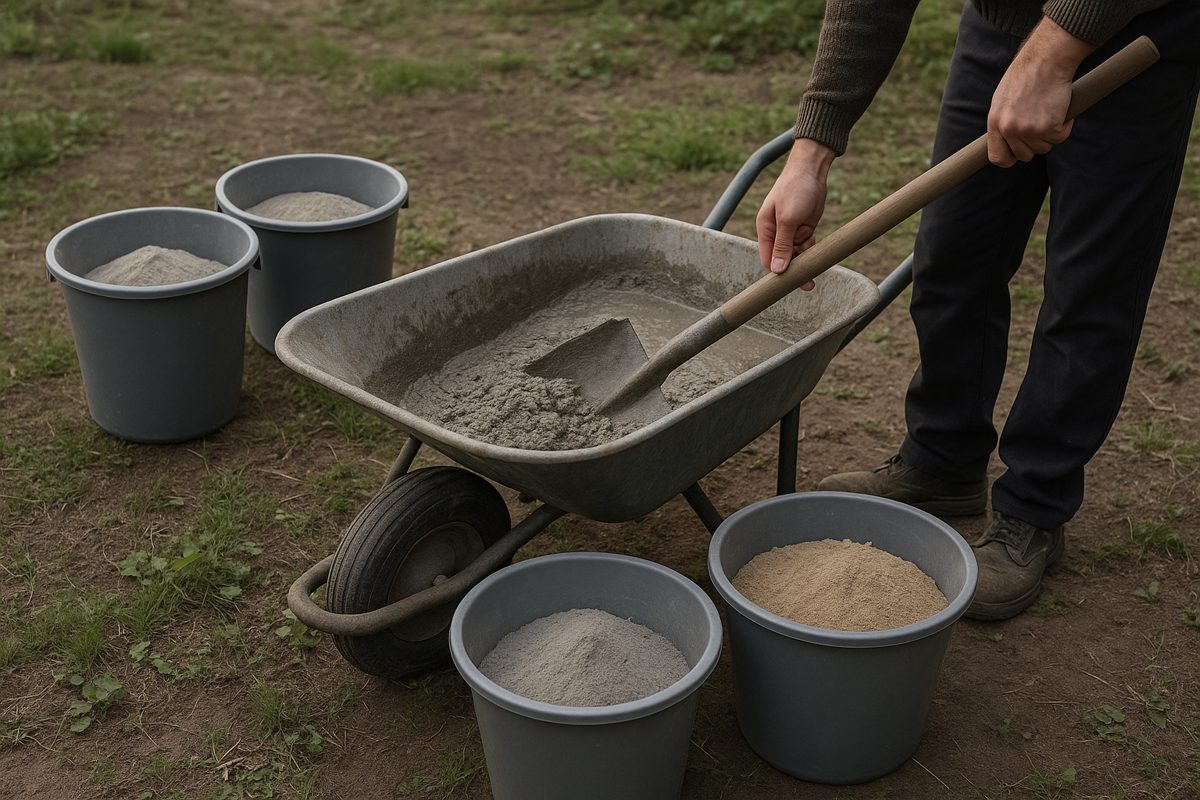
The mix, bucket by bucket Illustration -
5
Fill in layers and drive out the air.
Place it within 30 minutes of mixing, in layers no deeper than 150 mm. Push a bar or batten into each layer and knock on the form to work out trapped air. Do not drop it more than 1 m.
Rodding the first layer -
6
Leave the forms on and keep wet for 7 days.
Forms left in place count as curing. Keep the top wet or covered. The forms can come off after 3 days, but leaving them on for 7 makes curing easier.
Filled form under plastic
Specifications
| Part | Sieve size | Thickness | How |
|---|---|---|---|
| Concrete | 8–16 mm or 4–8 mm | as the form | 1 : 2 : 4, layers ≤ 150 mm, compacted, form knocked. |
Stone size rules
The largest stone must be no more than one fifth of the narrowest width between form faces, and no more than three quarters of the clear gap between bars (ACI 318). In Europe EN 1992-1-1 recommends a clear gap between bars of at least the largest stone plus 5 mm. Some countries set less in their national annex; Germany, for example, adds nothing for stone up to 16 mm. The checker uses the strictest of these.
Wall thickness
FAO: walls at least 100 mm thick, 150 mm if reinforced, and at least 200 mm if they are over 1 m high. In reinforced work, 20 mm is normally the largest stone.
Mix
This page uses the same 1 : 2 : 4 as 4.1. Too much water leaves pores, lowers strength and increases shrinkage.
Slabs and toppings
For a flat slab cast in edge forms, the slab rule from 4.1 also applies: the largest stone is no more than a quarter of the thickness (FAO).
Sources
- ACI 318-19 §26.4.2.1 Largest stone ≤ ⅕ of form width, ⅓ of slab depth, ¾ of bar gap (American Concrete Institute FAQ)
- EN 1992-1-1 §8.2 Clear gap between bars at least the largest stone + k2, recommended k1 = 1.0 and k2 = 5 mm (J. M. Arrieta, Universidad Politécnica de Madrid: detailing slides from the Eurocode 2 workshop, Brussels 2011); German national annex k2 = 0 for stone up to 16 mm and 5 mm above (Landesamt für Bauen und Verkehr Brandenburg, Bautechnik-Tipp 16/01)
- FAO Farm Structures, ch. 3: Concrete: mixes and amounts per m³, stone ≤ ¼ of the thinnest part, sand silt test, bulk densities, layers ≤ 150 mm, keep wet at least 7 days, forms off after 3 days
- FHWA Highway Materials Engineering Course: the role of cement and water in concrete: a higher water–cement ratio lowers strength; drying shrinkage is governed by the total water content
- American Concrete Institute FAQ: consolidation: rodding for flowable mixes, tamping for stiff ones, vibration internal or external
- Mile High Flood District: curing specification (based on ACI 308.1): cure at least 7 days, forms left in place count as curing
- EN 12620 Aggregates for concrete (DIN)
- EN 206 Concrete: specification, performance, production and conformity (EVS; withdrawn from 1 October 2026 and replaced by EN 206-1:2026 and EN 206-2:2026)
- EN 197-1 Cement: composition, specifications and conformity criteria for common cements (EVS)
How the amounts are worked out: FAO's table of sand, stone and cement per m³ of concrete, times the volume. Loose stone is counted at 1.55 t/m³ and moist sand at 1.4 t/m³, inside FAO's ranges of 1.5–1.65 and 1.3–1.5 t/m³. Amounts include no waste; FAO allows 5–10 % for waste and spill.
GLAREUM.NET · Aggregate Handbook