7.6 Block paving driveway
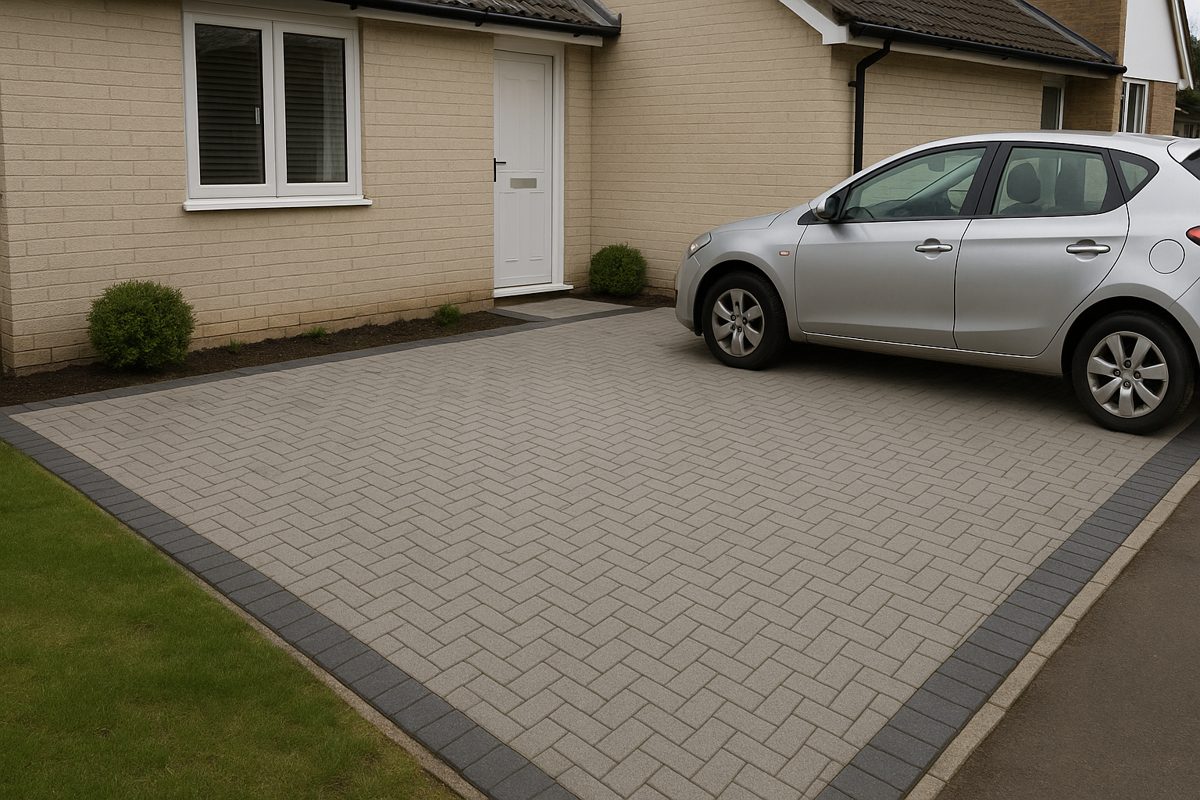
Concrete pavers laid in a locking pattern on sand and a stone base, held in by a firm edge. A hard drive that you can lift and relay.
At a glance
- Difficulty
- 3 of 4
- Time
- 4–6 days for 30 m², with a helper
- Tools
- Spade, wheelbarrow, plate compactor with a rubber mat, screed rails and board, string lines, masonry saw or block splitter, stiff broom, spirit level
- Parts
-
- 1 Base
- 2 Bedding sand
- 3 Pavers and joint sand
- 4 Edge restraint
What you need per m²
| Material | Size | Type | Amount |
|---|---|---|---|
| Base (3.2) | 0–32 mm | Crushed, with fines, 150–225 mm | 345–460 kg |
| Bedding (3.3) | 0–4 mm | Washed sharp sand, 25–30 mm loose | 50–65 kg |
| Pavers | 60 or 80 mm thick | Concrete, length no more than 4 × thickness | 1 m² + cuts |
| Joint sand (3.4) | 0–2 mm | Fine sand, dry | 4 kg |
| Edge restraint | – | Concrete kerb, or edging on a concrete haunch (7.8) | Full edge |
Why 60 or 80 mm?
For a home drive used by cars. A road standard uses 60–80 mm blocks on residential streets, and a UK council uses 65 mm for crossings that serve one or two houses (see 3.2). Use 65 mm or more for a home drive.
For steady vehicle traffic: shared drives, parking areas, vans and delivery trucks. Road authorities use 80 mm for carriageways and vehicle entrances.
Which laying pattern?
Use this on a drive. No joint runs straight for more than two blocks, so each paver is held on all sides. Road authorities use it where vehicles drive; one notes that it performs far better under vehicles than other patterns.
Fine for paths and patios, weaker on a drive. Under traffic, pavers tend to creep in the direction the wheels travel, and herringbone locks them best. Use herringbone where cars drive.
Step by step
-
1
Plan the levels and the fall.
Mark out the drive, the finished level and where water goes (7.1). Give the surface a fall of at least 2 %, away from the house. Dig deep enough for base, bedding and paver.
String lines set to the fall -
2
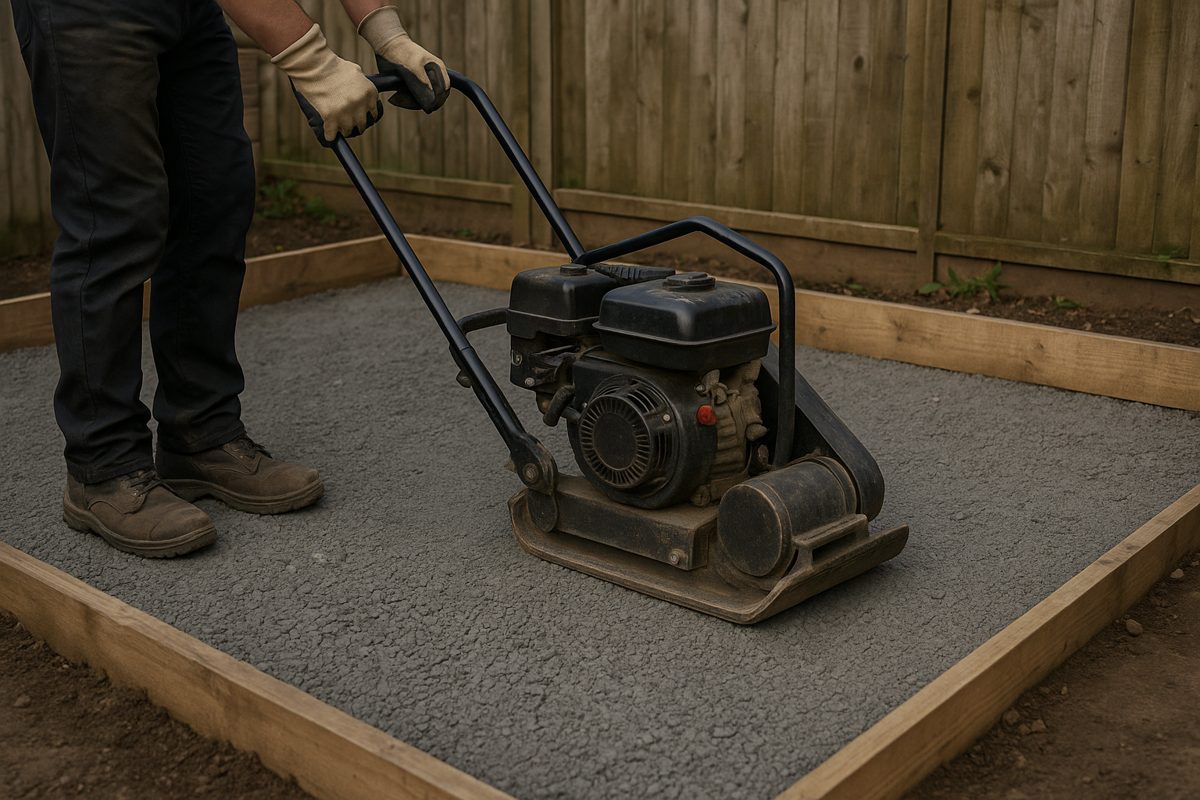
Build and compact the base.
Lay 150–225 mm of 0–32 mm crushed stone in layers and compact each one, as in 3.2. Put the fall into the base, not the sand. For pavers that let water through, build an open-graded base instead (6.2).
Compacting the base Illustration -
3
Set the edge restraint first.
Build the kerb or edging before you lay a single paver, on the base, at finished level (7.8). On a drive use concrete: a kerb, or edging set in a concrete haunch. Without a firm edge, the pavers spread and the joints open.
Kerb set in a concrete haunch -
4
Screed the bedding sand, only what you will pave today.
Pull 25–30 mm of loose 0–4 mm sand level over rails, as in 3.3. Do not compact it, and do not walk on it. Never use the sand to fill dips in the base.
Screeding over rails -
5
Lay from the edge, standing on the laid pavers.
Start at the edge restraint, at the low end on a slope, and work forward in one direction. Place each paver straight down, do not slide or hammer it into the sand. Lay all whole pavers first. Check the pattern against string lines every 5 m or so.
Placing a paver straight down -
6
Cut and fit the edge pieces.
Cut with a masonry saw or a block splitter. Where tyres run, no cut piece may be smaller than a third of a paver. Plan the pattern so you avoid slivers; fill any gap too small for a paver with concrete.
Marking a cut -
7
Compact the pavers into the sand.
Run a plate compactor with a rubber mat over the pavers, at least two passes, until they sit level with each other. Stay 1.5 m back from any edge that is not yet restrained. Lift and replace any paver that cracks.
Plate compactor with a rubber mat -
8
Fill the joints and compact again.
Sweep dry 0–2 mm sand over the surface and vibrate it in until the joints are full (3.4). By the end of each day, fill and compact everything except the last 1 m at the laying face. Sweep off the extra sand.
Sweeping in joint sand -
9
Open it to cars once every joint is full.
Drive on it only when the joints are filled and compacted. Top up the joints over the first months as the sand settles.
The finished drive in use
Specifications
| Part | Size or type | Thickness | How |
|---|---|---|---|
| 1 Base | 0–32 mm | 150–225 mm | Compacted in layers, as 3.2. |
| 2 Bedding | 0–4 mm | 25–30 mm | Loose, screeded, as 3.3. |
| 3 Pavers, cars | Concrete | 65 mm or more | Herringbone 45° or 90°. |
| 3 Pavers, steady traffic | Concrete | 80 mm | Length at most 4 × thickness. |
| Joints | 0–2 mm | 2–5 mm wide | Dry sand, vibrated full, as 3.4. |
| 4 Edge | Concrete | – | Built before laying. |
Paver thickness and shape
A road standard uses 60 mm blocks for footpaths and cycle tracks, 60–80 mm for residential and light commercial streets and 80–100 mm for bigger roads. Road authorities use 60 mm for footways and 80 mm for carriageways and vehicle entrances. The same standard defines a paver block as no longer than 4 times its thickness.
Pattern
Road specifications recommend herringbone at 45° or 90° under vehicles; one road authority makes 45° herringbone its default. A road authority names creep of pavers along the direction of traffic as a common failure.
Edge restraint
Road standards hold the edges with concrete kerbs or edge blocks, formed before the pavers next to them are laid and compacted. For edging options, see 7.8.
Cuts
Cut pieces under vehicles should be at least a third of a paver. One road authority allows a quarter in 45° herringbone; another sets 50 mm as the smallest dimension and fills smaller gaps with concrete or mortar.
Compaction
Use a plate of at least 22 kN at 75–95 Hz. Compact the pavers with at least two passes, then sweep in joint sand and vibrate it in until the joints are full. Do not compact within 1.5 m of an unrestrained edge or 1 m of the laying face. The finished surface sits flush with or up to 6 mm above drains and edges, and is within 10 mm under a 3 m straightedge.
Slopes and permeable paving
Give the surface a fall of at least 2 %. On slopes of 8 % or more, pavers are more likely to work loose; lay from the lowest point uphill and get advice before paving a drive that steep. Permeable pavers have wider joints filled with fine clean stone and sit on an open-graded base: see 6.2.
Bedding thickness
This page follows 3.3: 25–30 mm loose. Sources vary: road standards give 25–50 mm loose and 20–40 mm compacted, 25 mm loose, 20–30 mm finished and 30 mm.
Sources
- UFGS 32 14 13.13, Interlocking precast concrete unit paving (US Department of Defense, 2019): joints not “less than 2 mm 1/16 in or more than 5 mm 3/16 in in width”; bedding sand screeded to “an uncompacted average thickness of 25 mm 1 in”; edge restraints placed before the units; cut with a hydraulic splitter or masonry saw; at least three plate passes; no seating or jointing within 1.5 m (5 ft) of an unrestrained edge; units flush with or up to 6 mm (¼ in) above edge restraints and drainage structures; at most 10 mm (⅜ in) under a 3 m (10 ft) straightedge
- Virginia DEQ, stormwater design specification No. 7: permeable pavement: “Compact and seat the pavers into the bedding course with a minimum low-amplitude 5,000-lbf, 75- to 95-Hz plate compactor” (written for permeable pavers)
- Bureau of Indian Standards, IS 16777:2019 Laying of paver blocks, code of practice: herringbone 45° or 90° to traffic; 60 mm blocks for footpaths, 60–80 mm for residential and light commercial streets, 80–100 mm for collector and arterial roads; a paver block has an “aspect ratio not more than four”; joints “normally 2 to 4 mm wide”; bedding 25–50 mm loose, 20–40 mm compacted; “the end of the day's work should in any case complete the process” of joint filling; “compaction should not proceed closer than 1m from the laying face”; a cross fall of 2 % is generally sufficient; edge restraints stop sideways movement; lay from the edge, from the lowest point uphill on slopes, in one direction, working on the completed surface; whole blocks first, no forcing or hammering into the sand; string lines about every 5 m; no cut smaller than 50 mm, fill with concrete or mortar; at least two compaction passes; no traffic until all joints are filled
- Hong Kong Highways Department, RD/GN/044C Guidance notes on pavements with paving units (2022), and RD/GN/044B (2020): herringbone required on vehicle entrances and performs far better under vehicles; horizontal creep of paving units along the direction of the predominant traffic flow is a common failure; footways with steep gradients (8 % or larger) are a vulnerable condition for paving units; 60 mm for footways, 80 mm for carriageways; edge restraints formed before laying and compacting; cuts at least a third, a quarter in 45° herringbone; sand bedding 20–30 mm finished
- Main Roads Western Australia, Specification 505 Segmental paving (2026): 45° herringbone by default; bedding 30 mm screeded just ahead of laying; whole pavers first, cut closures with a saw and fit last; two plate passes, joint filling, two more passes
- ACT Government (Canberra), Standard specification for urban infrastructure works, section 12 Segmental paving: herringbone for road pavements; jointing sand dry when spread; initial compaction of at least two coverages, then joint sand and further compaction; vehicles may use it once the joints are filled; remove excess sand before opening
- FHWA-RD-97-148, Granular base: natural aggregates weigh about 2.0–2.3 t/m³
- Penn State University, CE 584 concrete course notes: aggregates: aggregate for normal concrete weighs 1,520–1,680 kg/m³
- EN 1338 Concrete paving blocks
Amounts: compacted base at about 2.3 t per m³ (top of the FHWA range, as on 3.2) and bedding sand at about 1.6 t/m³ (Penn State course notes), matching 3.2; joint sand from 3.4. No waste is included; order a little extra. The materials and sizes of bedding and joint sand follow 3.3 and 3.4.
GLAREUM.NET · Aggregate Handbook