4.1 Casting a concrete floor
A flat, load-bearing slab on the ground, for example in a garage, shed, workshop or basement.
At a glance
- Difficulty
- 2 of 4
- Time (estimate)
- 1 day for 20 m²
- Tools
- Wheelbarrow, mixer, screed board, float, rake, plate compactor, spirit level
- Parts
-
- 1 Capillary break
- 2 Sand blinding
- 3 Concrete slab
What you need per m², 100 mm slab
| Material | Size | Type | Amount |
|---|---|---|---|
| Capillary stone | 16–32 mm | Washed, no fines | 230 kg |
| Sand (blinding) | 0–4 mm | Washed | 70 kg |
| Sand (concrete) | 0–4 mm | Washed | 62 kg |
| Stone (concrete) | 8–16 mm | Crushed or rounded | 136 kg |
| or | 4–8 mm | For sections under 64 mm | |
| Cement | – | Common cement (EN 197-1) | 29 kg |
| Steel mesh | – | On spacers, lapped at joins | 1 m² + laps |
Why 4–8 or 8–16?
For thin sections under 64 mm, such as a topping. The largest stone must stay under a quarter of the thickness, so 16 mm stone needs at least 64 mm.
For floors 100 mm and thicker. Bigger stone needs less mixing water, and less water gives stronger concrete that shrinks less.
Step by step
-
1
Dig out and level the ground.
Remove topsoil and roots. Dig to 300 mm below finished floor level so all three layers fit.
Arrow at the level line -
2
Lay 150 mm of 16–32 mm washed stone and compact.
This is the capillary break. Single-size stone with no fines stops water rising to the underside of the floor.
Compacting the stone layer -
3
Lay 50 mm of 0–4 mm washed sand, level it and set the mesh.
The sand gives a level bed so the concrete does not run down into the stone. Sand tipped straight onto 16–32 mm stone washes down into the gaps, so lay a geotextile on the stone first, or a thin layer of 4–8 mm grit (see 6.6 Filter layer). Put the steel mesh on spacers so concrete gets under it.
Screeding the sand bed -
4
Mix concrete: 1 part cement, 2 parts sand, 4 parts stone.
Measure by bucket. Add water a little at a time. Use only as much as you need to work the mix, because extra water makes it weaker.
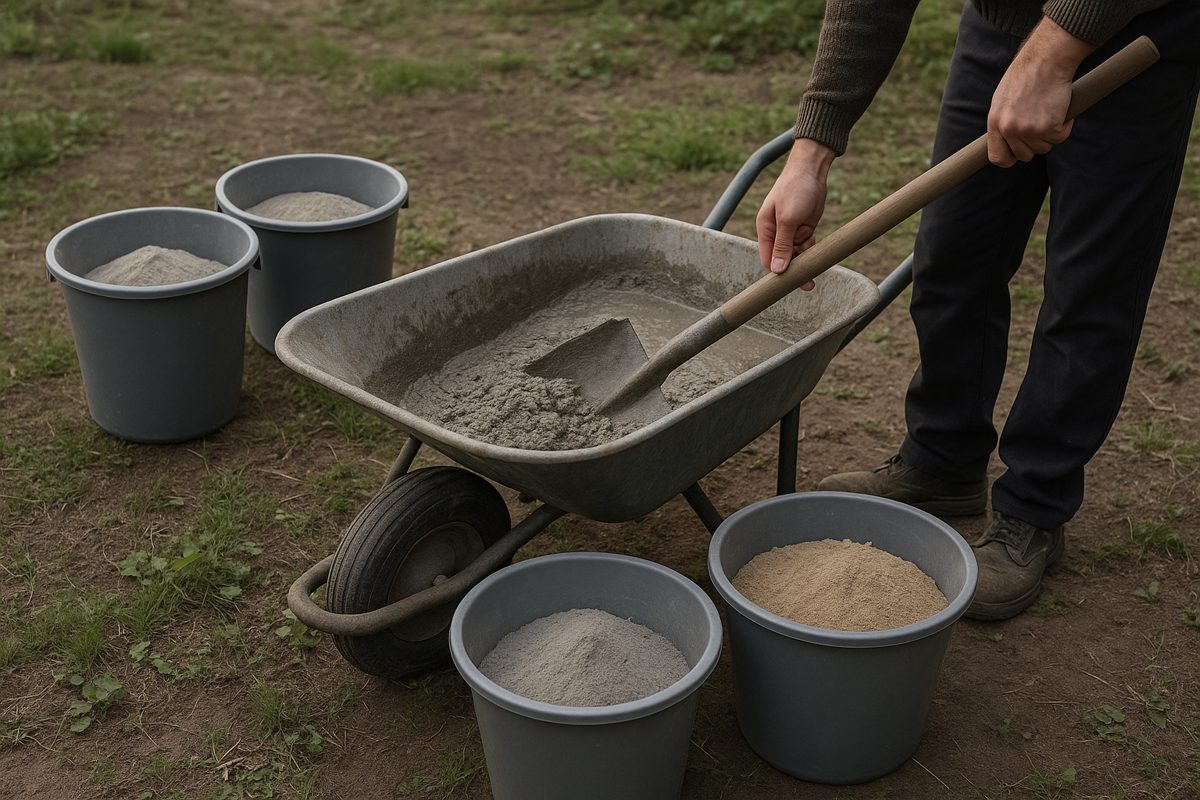
The mix, bucket by bucket Illustration -
5
Pour, compact, screed level, float the surface.
Place the concrete within 30 minutes of mixing, and tamp it so no air is trapped.
Floating the surface -
6
Keep wet for at least 7 days.
Start within 10 to 12 hours of casting. Keep the surface wet or covered. Concrete only keeps gaining strength while it stays moist.
Slab kept wet
Specifications
| Part | Sieve size | Thickness | How |
|---|---|---|---|
| 1 Capillary break | 16–32 mm | at least 150 mm | Compacted. Washed, single-size, no fines. |
| 2 Sand blinding | 0–4 mm | about 50 mm | Screed level, on a geotextile or 4–8 mm grit so the sand cannot wash into the stone (6.6). |
| 3 Concrete slab | 8–16 mm | at least 100 mm | 1 : 2 : 4. Steel mesh on spacers. Compact, then float. |
Mix
FAO gives 1 : 2 : 4 by volume for floors with heavy loads, such as stores and repair shops, on a firm base. Strength depends heavily on the water: too much water leaves pores, lowers strength and makes the concrete shrink more as it dries.
Stone size and slab thickness
The largest stone must be no more than a quarter of the slab thickness (FAO). ACI 318 allows up to a third. A 100 mm slab takes stone up to 25 mm, so 8–16 mm fits.
Capillary break and slab
At least 150 mm of washed stone with no fines (Bolius, US Department of Energy). FAO gives 150–200 mm. The slab is at least 100 mm and reinforced (Bolius). See 6.1.
Heated rooms
A heated floor also needs pressure-resistant insulation between the capillary break and the slab (Bolius). How much depends on the climate. The insulation is not covered here.
Sources
- FAO Farm Structures, ch. 3: Concrete: mixes and amounts per m³, stone ≤ ¼ of the thinnest part, sand silt test, bulk densities, layers ≤ 150 mm, keep wet at least 7 days, forms off after 3 days
- FAO Farm Structures, ch. 5: Floors: coarse stone 150–200 mm against rising water, sand 50 mm under the membrane, 1 : 2 : 4 for heavily loaded floors, stone ≤ ¼ of slab thickness
- Bolius (non-profit): ground-bearing floors: capillary break at least 150 mm, reinforced slab at least 100 mm, mesh on spacers
- US Department of Energy: capillary break under slabs: uniform crushed stone with no fines
- ACI 318-19 §26.4.2.1 Largest stone ≤ ⅕ of form width, ⅓ of slab depth, ¾ of bar gap (American Concrete Institute FAQ)
- Penn State University: aggregate and strength: mixes with larger stone need less mixing water
- FHWA Highway Materials Engineering Course: the role of cement and water in concrete: a higher water–cement ratio lowers strength; drying shrinkage is governed by the total water content
- University of Wisconsin: aggregate coatings: clay coatings on aggregate significantly decrease strength and durability
- Mile High Flood District: curing specification (based on ACI 308.1): cure at least 7 days, forms left in place count as curing
- EN 12620 Aggregates for concrete (DIN)
- EN 13242 Aggregates for unbound and hydraulically bound materials (Estonian Centre for Standardisation)
- EN 206 Concrete: specification, performance, production and conformity (EVS; withdrawn from 1 October 2026 and replaced by EN 206-1:2026 and EN 206-2:2026)
- EN 197-1 Cement: composition, specifications and conformity criteria for common cements (EVS)
How the amounts are worked out: FAO's table of sand, stone and cement per m³ of concrete, times the volume. Loose stone is counted at 1.55 t/m³ and moist sand at 1.4 t/m³, inside FAO's ranges of 1.5–1.65 and 1.3–1.5 t/m³. Amounts include no waste; FAO allows 5–10 % for waste and spill.
GLAREUM.NET · Aggregate Handbook