7.3 Compacted gravel driveway
A top layer of crushed stone with fines, compacted hard. A path or drive you can walk or drive on, without paving. Other driveway surfaces are compared in chapter 7; upkeep is in 7.9. Garden paths are in chapter 8: self-binding gravel (8.2) and decomposed granite (8.3).
At a glance
- Difficulty
- 2 of 4
- Time
- 1–2 days for 30 m²
- Tools
- Spade, wheelbarrow, rake, plate compactor or roller, hose with a spray nozzle, string line
- Parts
-
- 1 Base
- 2 Surface
What you need per m²
| Material | Size | Type | Amount |
|---|---|---|---|
| Base, path | 0–32 mm | Crushed, with fines, 100 mm (3.1) | 230 kg |
| Surface, path | 0–8 mm | Crushed, with fines, 75 mm | 175 kg |
| Base, drive | 0–32 mm | Crushed, with fines, 150 mm (3.2) | 345 kg |
| Surface, drive | 0–16 mm | Crushed, with fines, 100 mm | 230 kg |
Why with fines?
For paths. Small stones and plenty of fines pack into a smooth, firm surface for feet, bikes and wheelchairs. Trail guidance uses stone up to about 10–12 mm.
For drives. The fines bind the stones so wheels do not push them aside. Road guidance asks for all of it to pass 25 mm and 8–15 % fines, more than a base needs.
Step by step
-
1
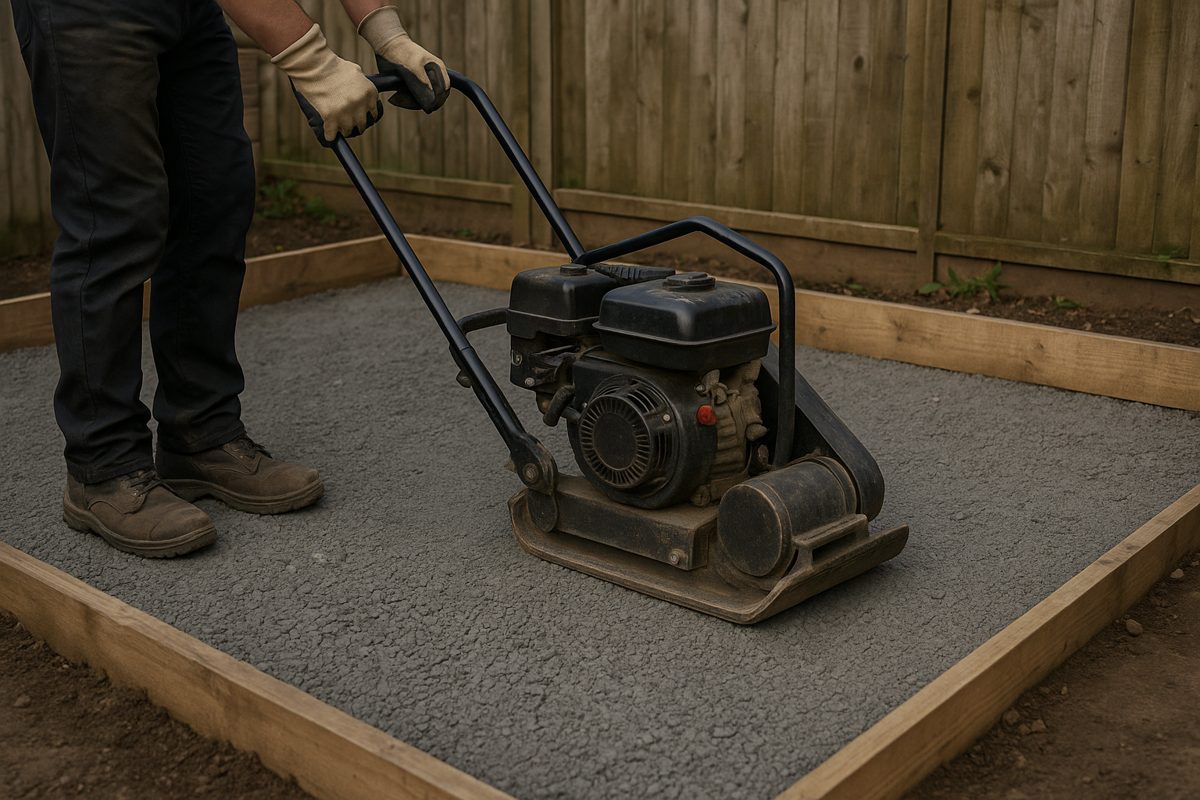
Build the base with the fall already in it.
Use 3.1 for a path (100 mm) and 3.2 for a drive (150 mm). Give it a crown or a crossfall of 2–4 %, so the surface sheds water.
Compacting the base Illustration -
2
Check the surface stone is damp.
It should hold together when you squeeze a handful, without water running out. Mist dry stone with a fine spray and turn it over.
A squeezed handful -
3
Spread it about a third thicker than the finished layer.
It shrinks by 20–30 % when compacted. For 75 mm finished, spread about 100 mm loose.
Raking to the string line -
4
Compact until the surface is hard and closed.
Use a plate compactor or roller, with the same crown or fall as the base. Thicker layers than 100 mm go down in two layers.
The finished, crowned surface -
5
Keep it in shape.
Rake loose stones back, fill ruts and potholes with the same stone and compact again. Keep a little spare stone from the same delivery.
Filling a rut
Specifications
| Part | Sieve size | Thickness | How |
|---|---|---|---|
| 1 Base | 0–32 mm | 100–150 mm | As 3.1 for paths, 3.2 for drives. |
| 2 Surface, path | 0–8 mm | 75–100 mm | Crushed with 6–20 % fines. Crossfall about 2 %. |
| 2 Surface, drive | 0–16 mm | at least 75 mm | Crushed with 8–15 % fines. Crown about 4 %. |
Fines
The surface needs more fines than a base, because the fines are the binder. Road guidance asks for 8–15 % passing 0.075 mm with a little plasticity (PI 4–9). Trail guidance gives 6–15 % and 12–20 %. A base mix allows at most 9 %. Too many fines turn the surface to mud when it is wet.
Thickness
Road guidance asks for at least 75 mm of surface gravel; one road guide gives 75–100 mm. Trail guidance gives about 75 mm compacted (100 mm loose) and 100–125 mm.
Water content
Compact it at its best water content. Trail guidance gives about 4–5 %. Too dry and it does not bind, too wet and it turns soft.
Falls
Paths: a crown or crossfall of about 2 %, or 3–4 % where wheelchair access does not matter. Drives: a crown of about 4 %.
Sources
- Gravel roads guidance (Skorseth, Western Transportation Institute): surface gravel at least 75 mm, all passing 25 mm, 8–15 % fines passing 0.075 mm, plasticity index 4–9; crown about 4 %
- Maine DOT local roads guidance: 75–100 mm surface gravel with 7–12 % fines; fines keep the surface compacted, too many fines turn it to mud
- Building crusher fines trails (L. Bachensky, USDA Forest Service, via American Trails): 0–9.5 mm crushed stone with 6–15 % fines, 100–125 mm compacted, 20–30 % extra for compaction; water content 4–5 %; crown or cross slope 2 %; grades kept under 5 % where possible, never over 8 %
- Penn State Center for Dirt and Gravel Roads, trail surface aggregate bulletin: 0–12.5 mm with 12–20 % fines; at least 100 mm loose, about 75 mm compacted; compacted at optimum water content; cross slope 3–4 %, built into the base too
- Specification for Highway Works, Series 800 (Nov 2021): unbound mixtures to EN 13285: a 0/31,5 Type 1 mixture passes 75–99 % at 31.5 mm, 43–81 % at 16 mm, 12–53 % at 4 mm and at most 9 % at 0.063 mm (Table 8/6a); fines non-plastic (clause 803.4); aggregate properties from EN 13242 (clause 801.4)
- FHWA-RD-97-148, Granular base: natural aggregates weigh about 2.0–2.3 t/m³ in place
- Wisconsin DOT / Wisconsin Highway Research Program, Weight-volume relationships and conversion factors for soils and aggregates (2023): compacted dense-graded base 1.80–1.86 tons per cubic yard (about 2.1–2.2 t/m³); it swells 36–47 % in volume from compacted to loose
- Penn State University, CE 584 concrete course notes: aggregates: aggregate for normal concrete weighs 1,520–1,680 kg/m³
- NPTEL (Indian Institutes of Technology), soil mechanics worked examples: dry sand about 1,600 kg/m³
- EN 13285 Unbound mixtures: specifications. Mixtures are named 0–D, for example 0–32
- EN 13242 Aggregates for unbound and hydraulically bound materials
- EN 13286-2 Laboratory test for density and water content, Proctor compaction (scope)
Amounts: compacted base and gravel at about 2.3 t per m³, the top of the 2.0–2.3 t/m³ that FHWA gives for natural aggregate in place, so the amounts err on the generous side (a Wisconsin DOT study measured about 2.1–2.2 t/m³ for compacted dense-graded base); bedding sand at about 1.6 t/m³ (Penn State course notes; NPTEL). No waste is included; order a little extra. Trail guidance uses 0–9.5 and 0–12.5 mm; 0–8 mm is the nearest common size.
GLAREUM.NET · Aggregate Handbook