1.2 Crushed or rounded
Crushed stone has sharp edges and rough faces, so the grains lock together. Rounded gravel was smoothed while rivers or glacial meltwater carried it, so the grains slide past each other.
At a glance
- Crushed
- Quarried rock, boulders or large cobbles, broken in a crusher. Angular grains.
- Rounded
- Natural sand and gravel, dug from river, glacial, beach and sea-bed deposits.
- Carries load
- Crushed. Bases, sub-bases, paving beds and fill.
- Must flow
- Rounded is easier to work. Concrete and mortar.
Why it matters
Angular grains interlock. A compacted base of crushed stone is more stable under load than one of rounded gravel.
Round grains do not interlock as well. In concrete they need less water for the same workability, but in a base they give less stability.
Which to pick
| Job | Crushed | Rounded | Why |
|---|---|---|---|
| Bases and sub-bases (3.1, 3.2) | Yes | No | Must interlock under load. |
| Paving bed and grit joints (3.3, 3.4) | Yes | No | Must interlock so pavers stay put. |
| Structural fill and backfill (2.2, 2.3) | Yes | Possible | Rounded fill is less stable. |
| Concrete (chapter 4) | Yes | Yes | Rounded needs less water and sand. Crushed bonds better and gives higher bending strength. |
| Mortar and render (5.1, 5.2) | Possible | Easier | Crushed sand is harsher to work. |
| Drainage and capillary break (chapter 6) | Yes | Yes | Both leave about 30–40 % open space when washed and single-size. |
Step by step: tell them apart
-
1
Look at a handful.
Crushed stone has flat faces that meet at sharp edges. Rounded stone looks like pebbles, with no flat faces.
Crushed and rounded stones on a palm -
2
Rub two stones together.
Crushed stone feels rough and catches. Rounded stone slides smoothly.
Rubbing two crushed stones -
3
Pour a small heap.
Crushed stone stands in a steep cone. Rounded stone runs out into a lower, wider heap.
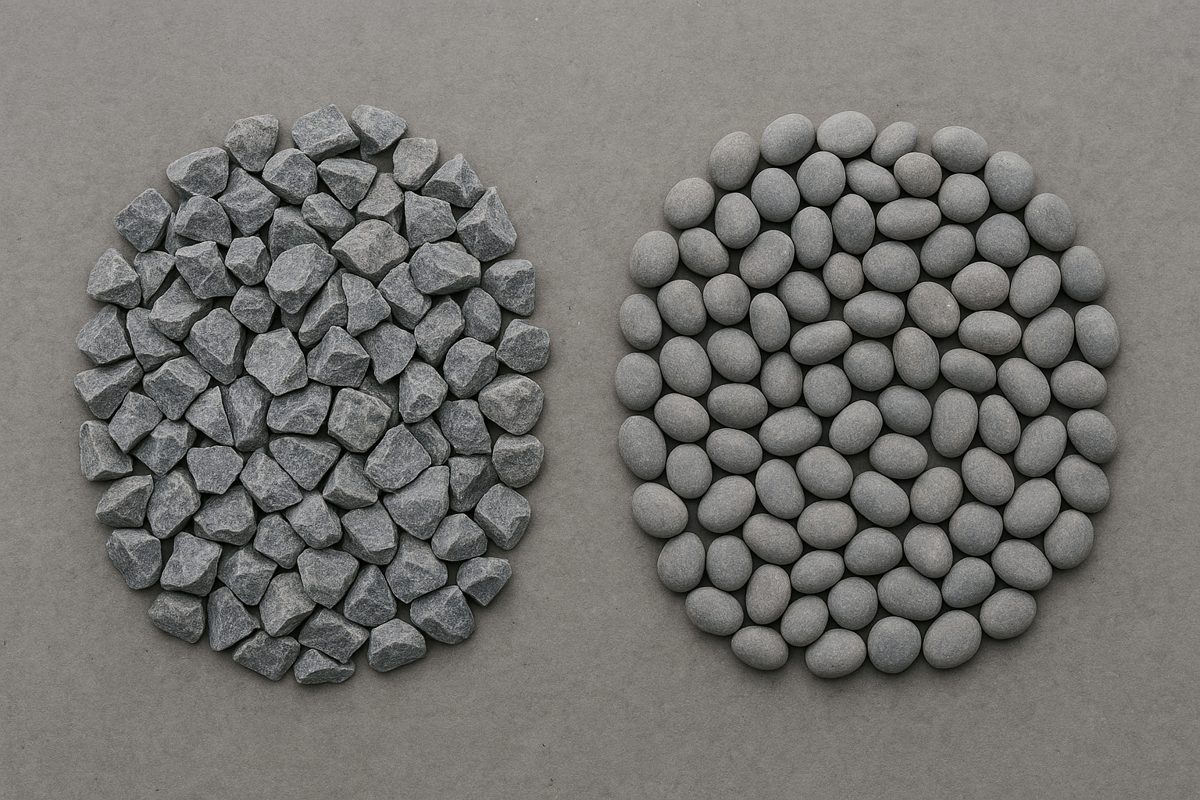
Two heaps from the same bucket size Illustration
Specifications
Crushed faces
EN 933-5 measures the share of grains with crushed or broken faces, and ASTM D5821 counts fractured faces. Specifications use it to grade how crushed a material is. One highway specification asks for category C90/3 for crushed rock but only C50/10 for crushed gravel, so crushed gravel can be partly rounded.
Flat and long stones
EN 12620 sets categories for flaky and long stones, tested with EN 933-3 (flakiness index) and EN 933-4 (shape index). Long, flat or very angular particles need more fine material in concrete.
In concrete
More angular, less round stone needs more mixing water for the same workability. Rough, crushed stone gives a bigger surface for the cement paste to bond to, and concrete made with rounded gravel is weaker in bending than concrete made with crushed stone.
Sand shape
Manufactured (crushed) sand is generally more angular and has more fines than natural sand. It makes harsher mixes.
Sources
- USGS Bulletin 1594, Natural Aggregates of the Conterminous United States: crushed stone from crushing rock, boulders or cobbles; sand and gravel rounded in transport, dug from river, glacial, beach and marine deposits
- TxDOT, flexible base guidelines: rounded particles do not interlock as well as crushed ones; crushed materials have higher stability
- Kleinhans et al., angles of repose of granular materials (University of Amsterdam): angular grains about 40°, rounded grains about 25°
- ACI Education Bulletin E1-07, Aggregates for Concrete: angular stone needs more mixing water; rough texture gives more surface for bond; the more angular and rough the stone, the greater the percentage of voids
- Austroads AGPT04C, Materials for Concrete Road Pavements: rounded gravel gives concrete weaker in flexure; angular particles need more fine material; manufactured sand is harsher
- NCDOT research report 1998-06: manufactured sands are more angular and contain more fines than natural sands
- Oregon State University Extension EM 9204, Soakage trenches: washed, uniformly graded storage rock has about 40 % pore space
- University of Kentucky Cooperative Extension AEN-108, Permeable pavement for stormwater management: void space in the clean stone reservoir typically 30–40 %
- EN 933-5 Percentage of crushed and broken surfaces in coarse aggregate particles
- ASTM D5821 Percentage of fractured particles in coarse aggregate
- Highway specification Series 800: crushed surface categories C90/3 (crushed rock) and C50/10 (crushed gravel) under EN 13242
- EN 12620 overview slides, Spanish Ministry of Public Works: flakiness index (EN 933-3) and shape index (EN 933-4) categories
GLAREUM.NET · Aggregate Handbook