3.3 Sand bedding under paving
The thin, even layer of loose sand that pavers and slabs are pressed into. It evens out small differences between pavers. It does not level the base.
At a glance
- Difficulty
- 2 of 4
- Time
- 2–3 hours for 20 m²
- Tools
- Two steel pipes as screed rails, a straight screed board, rake, trowel, carpenter's level
- Parts
-
- 1 Base (ready)
- 2 Bedding sand
- 3 Pavers
What you need per m², 30 mm loose
| Material | Size | Type | Amount |
|---|---|---|---|
| Bedding sand | 0–4 mm | Washed, sharp, almost no dust | 50 kg |
| Screed rails | – | Two straight steel pipes | 1 pair |
Why sharp 0–4 sand?
Washed, angular sand with a spread of grain sizes and almost no dust. It drains and stays put when it is wet.
Fine, rounded masonry sand and stone dust drain slowly and can move under the pavers. Paving specifications ask for washed sand with almost no dust, which rules them out.
Step by step
-
1
Check the base first.
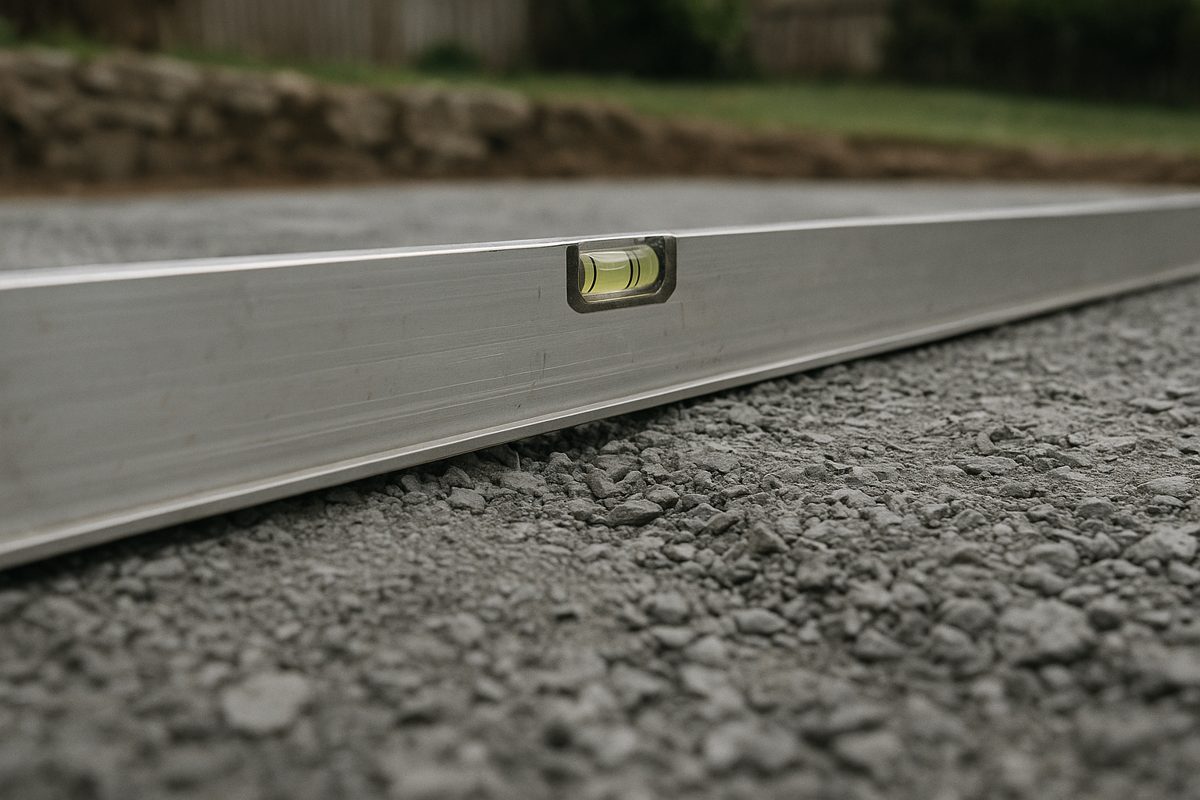
It should be within 10 mm under a 3 m straightedge, with the falls already in it. Fill dips with base material and compact. The sand only evens out the pavers.
Straightedge on the base Illustration -
2
Lay two pipes on the base as screed rails.
Set the tops so the screeded sand ends up 25–30 mm thick and follows the fall. Check them with a carpenter's level and string line.
Pipes set on the base -
3
Spread the sand and pull the board along the rails.
Rake the sand a little higher than the rails, then pull the board along them in short strokes. Take away the extra sand that builds up in front.
Screeding between the rails -
4
Lift the rails out and fill the grooves.
Fill each groove with sand and smooth it with a trowel. Screed only as much as you can pave the same day.
Troweling the rail groove -
5
Lay the pavers on the loose sand.
Do not compact the sand first, and do not walk on it. Work from the pavers you have laid. Vibrating them later presses them into the bed.
Laying from the paved side
Specifications
| Part | Sieve size | Thickness | How |
|---|---|---|---|
| Bedding | 0–4 mm | 25–30 mm loose | Screeded on rails. Not compacted, not walked on. |
| Permeable paving | clean grit | 50 mm | Washed crushed stone with almost no fines. See 6.2. |
Thickness
A US military paving specification screeds the sand to an average of 25 mm, uncompacted. A city footway drawing and two UK council specifications use 30 mm, one of them with at least 25 mm. A lab study tested 30 and 50 mm: 30 mm let the paving deflect less, 50 mm spread the load better.
Grading
A US military paving specification uses a concrete sand grading with a tighter dust limit: all passing 9.5 mm, 95–100 % passing 4.75 mm, 50–85 % passing 1.18 mm, 5–30 % passing 0.3 mm and at most 1 % passing 0.075 mm. A UK council asks for sharp sand to EN 12620 grading C or M, and another for 0/4 mm sand.
Height of the pavers
After vibrating, the paving should end up level with, or up to 6 mm above, drains and fixed edges. Leave the pavers a little proud of that when you lay them, because the bed compresses when you vibrate. How much depends on the sand; test a small area first.
Permeable paving
Under permeable paving the bed is about 50 mm of washed crushed stone instead of sand, so water can pass. That build-up is covered in 6.2.
Sources
- UFGS 32 14 13.13, Interlocking precast concrete unit paving (US Department of Defense unified facilities guide specification, 2019): a dense-graded base, within 10 mm under a 3 m straightedge; bedding sand screeded to an uncompacted average of 25 mm, left uncompacted and not walked on, and never used to fill low areas in the base; bedding sand to ASTM C33 with at most 1 % passing 0.075 mm; joint sand to ASTM C144 with at most 5 % passing 0.075 mm; joints 2–5 mm; gaps at edges at most 6 mm; at least three plate passes; no seating or joint filling within 1.5 m of an unrestrained edge; joint sand swept and vibrated until no more goes in; finished surface flush with or up to 6 mm above edges and drains
- ACT Government (Canberra), Standard specification for urban infrastructure works, section 12: segmental paving (2002): bedding never used for levelling; screed no further ahead than can be paved that day; joint sand dry when spread; laid joints 2–5 mm; plate fitted with a carpet or roller to protect the pavers; no compaction within 1 m of the working face
- City of Sydney standard drawing 2.4.3, footways: brick paving (2022): 150 mm of crushed rock (DGB20) compacted to 98 % of standard maximum dry density, under a 30 mm sand bed
- Bracknell Forest Council standard drawing SD/1100/04C, footway block paving (2019): 60 or 65 mm blocks only where no vehicles drive, 80 mm elsewhere; 30 mm sharp sand bed to EN 12620 grading C or M; 150 mm Type 1 sub-base, 300 mm on weak ground
- Bedford Borough Council, Appendix 11/1 Kerbs, footways and paved areas: block-paved light vehicle crossovers serving up to two houses: 65 mm blocks on 30 mm of 0/4 mm sand on 225 mm of Type 1 sub-base; sand layer at least 25 mm; joints filled with 0/2 mm sand
- Study: the effect of bedding thickness on interlocking block pavement performance: 30 mm resisted deflection better, 50 mm spread load better
- North Carolina DOT permeable paver specification: 50 mm bedding of washed crushed stone; joints filled with washed crushed stone with at most 2 % fines
- Penn State University, CE 584 concrete course notes: aggregates: aggregate for normal concrete weighs 1,520–1,680 kg/m³
- NPTEL (Indian Institutes of Technology), soil mechanics worked examples: dry sand about 1,600 kg/m³
- ASTM C33 Concrete sand grading, used with a tighter dust limit for bedding sand by UFGS 32 14 13.13 above
Amounts: bedding sand at about 1.6 t/m³ (Penn State course notes; NPTEL). No waste is included; order a little extra.
GLAREUM.NET · Aggregate Handbook