7.4 Gravel grid driveway
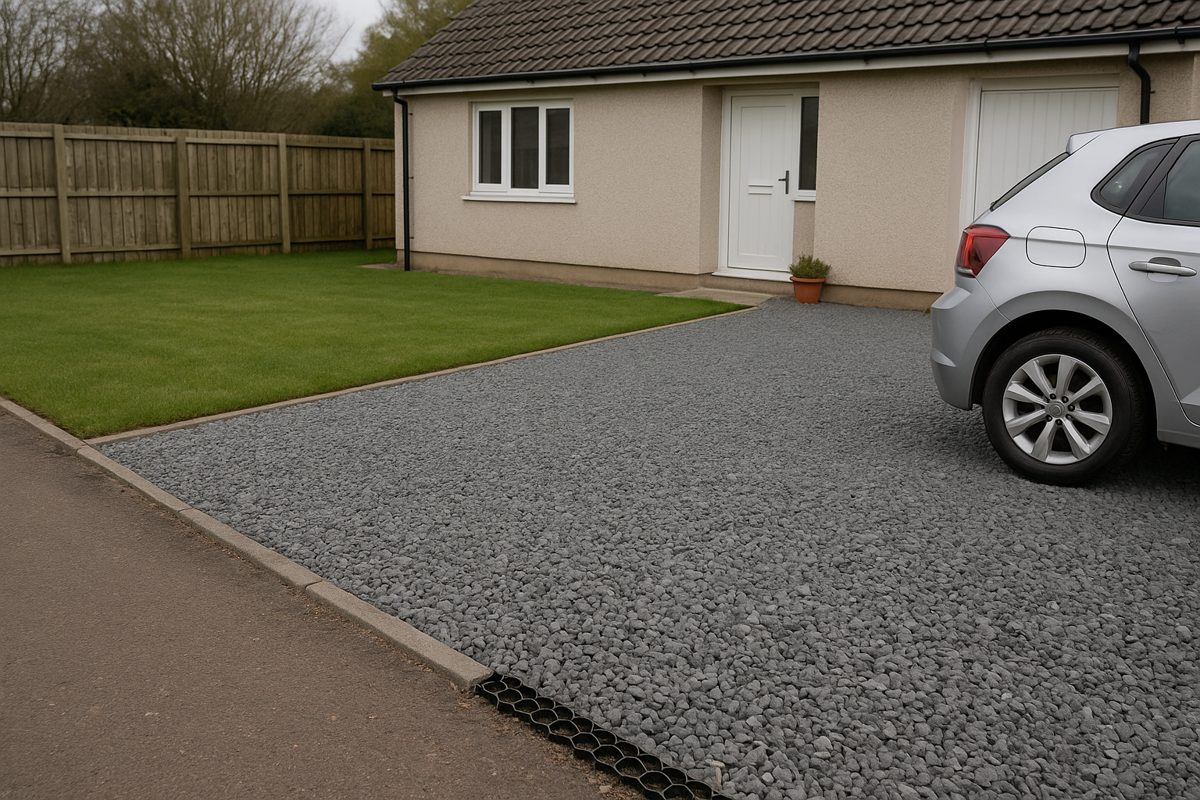
Plastic honeycomb grids filled with clean, angular gravel. The cells hold the stones in place, so the drive does not rut, scatter or form waves.
At a glance
- Difficulty
- 3 of 4
- Time
- 2–3 days for 30 m²
- Tools
- Spade or mini excavator, wheelbarrow, rake, plate compactor, screed rails and board, string line, carpenter's level, saw or knife for cutting grid panels, stiff broom
- Parts
-
- 1 Geotextile (if needed)
- 2 Base
- 3 Bedding
- 4 Grid and gravel fill
What you need per m²
| Material | Size | Type | Amount |
|---|---|---|---|
| Base, permeable | 4–20 mm | Washed, crushed, no fines, 150 mm (250 mm for more storage, 6.2) | 230 kg |
| or base, dense | 0–32 mm | Crushed, with fines, 150 mm (3.2) | 345 kg |
| Bedding grit | 2–8 mm | Washed, crushed, 25 mm | 35 kg |
| Grid fill | 2–8 or 4–8 mm | Washed, angular, crushed. Example: 40 mm deep grid | about 50 kg |
| Grid panels | – | Plastic cellular grid for vehicle use | 1 m² + cuts |
| Geotextile | – | Non-woven, only on soft or clay soil | 1 m² + laps |
| Edge restraint | – | Curb, edging or a paved strip (7.8) | Full edge |
Which base?
Choose this when rain should soak away through the drive. Clean stone has open voids that store water, and the grid fill lets it in. Build it as in 6.2. It needs sandy or gravelly soil below; on clay add a drain pipe (6.4) or choose the dense base.
Choose this on clay, or where you only want the grid to stop ruts. It compacts hard and carries the load well, but water mostly runs off, so give it a fall as in 3.2. Water quality manuals leave the grid base to traffic load and the grid maker.
Step by step
-
1
Check the slope and dig out.
Keep the drive under 5 % (1 in 20). Dig out base + 25 mm bedding + the grid depth, down to firm soil. Slope the bottom away from the house.
Dug-out bed with a string line -
2
On soft or clay soil, lay a geotextile.
It keeps soil from working up into the stone. Overlap the sheets by at least 300 mm. On firm ground you can leave it out.
Overlapping geotextile sheets -
3
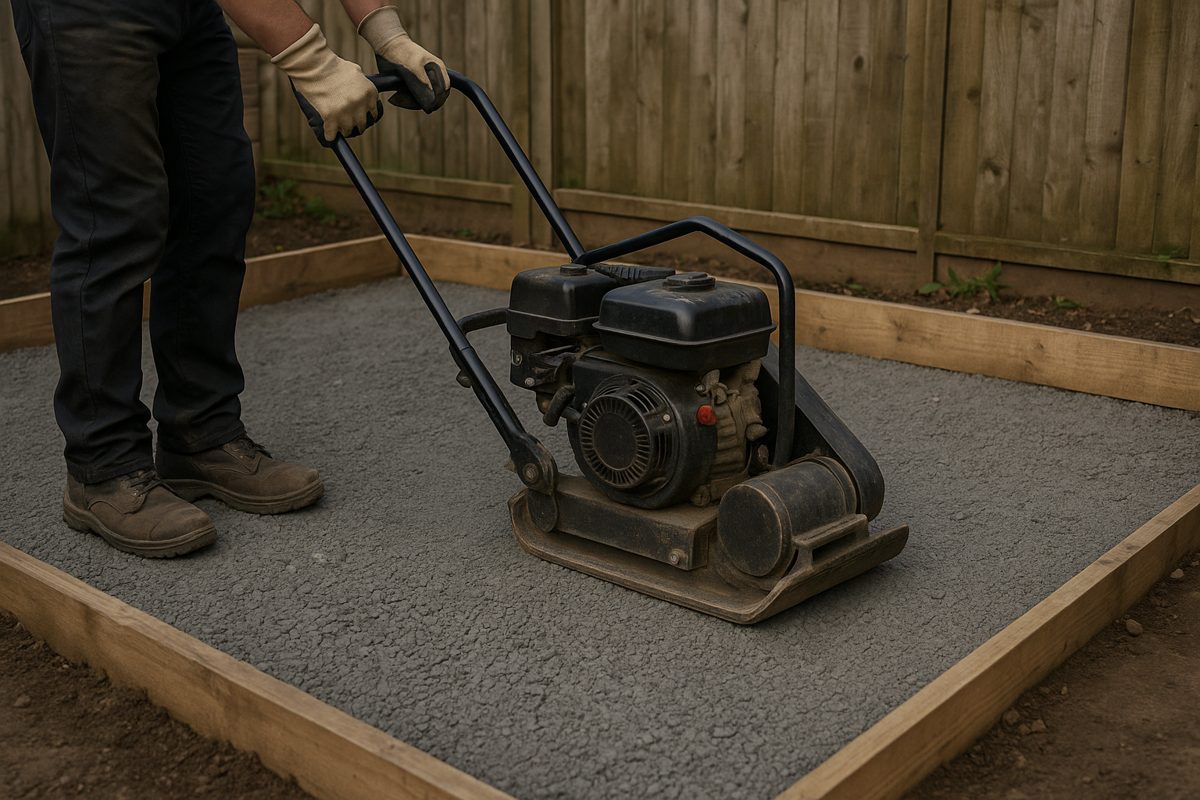
Build the base in compacted layers.
Open-graded 4–20 mm: layers of 100–150 mm, compacted until the stone stops moving (6.2). Dense 0–32 mm: layers of up to 100 mm (3.2).
Compacting the base Illustration -
4
Set the edges.
The grid and its gravel need a firm edge on every side, or the panels creep and stone spills out. Use a curb, edging or a paved strip (7.8). A strip of paving at the road end stops gravel being carried out.
Edging set along the base -
5
Screed a thin bedding layer.
Spread about 25 mm of 2–8 mm washed grit, screed it level on rails and compact it lightly. It gives the grid an even bed; the grid panels must not rock.
Screeding the grit -
6
Lay the grid panels.
Click or clip the panels together and cut them to fit the edges. Anchor them as the grid's instructions say. Lay from the bedding you have already covered, so you do not walk on the screeded grit.
Clipping grid panels together -
7
Fill the cells with angular gravel to the top.
Use 2–8 or 4–8 mm washed, crushed stone. Spread it, brush it into every cell and run over it with a plate compactor if the grid allows. Leave no more than 12 mm above the cell walls.
Brushing gravel into the cells -
8
Keep it topped up and clean.
Top up the cells with the same stone when they get low. Pull weeds and keep leaves and clippings off. If you clear snow, set the blade about 25 mm high so it does not catch the grid.
Topping up a worn patch
Specifications
| Part | Sieve size | Thickness | How |
|---|---|---|---|
| 1 Geotextile | – | – | On soft or clay soil. Laps at least 300 mm. |
| 2 Base, permeable | 4–20 mm | 150–250 mm | Washed, crushed. Layers of 100–150 mm. See 6.2. |
| 2 Base, dense | 0–32 mm | 150–225 mm | Crushed with fines. Layers up to 100 mm. See 3.2. |
| 3 Bedding | 2–8 mm | about 25 mm | Washed grit, screeded level, lightly compacted. |
| 4 Grid fill | 2–8 / 4–8 mm | grid depth | Washed, angular. At most 12 mm above the cells. |
Base thickness
UK government guidance for a permeable drive gives about 150 mm of compacted open-graded subbase (4/20 or similar, no fines) over a geotextile, about 200–250 mm of construction in all. A US state manual gives 75–150 mm of clean 19 mm gravel under modular grids; a New Hampshire watershed sheet gives 250 mm on sandy soil and 400 mm on other soils under a gravel grid drive with water storage. This page uses 150 mm, as in 3.2, and 250 mm where you want the base to store rain (6.2).
Bedding
A state manual gives a 25 mm layer on top of the gravel base under modular grids, compacted. Gravel-grid guidance from Vermont and Maine says not to use sand, so use grit of the same size as the fill. Under permeable paving the bedding is No. 8 stone (about 2–8 mm), typically 40–75 mm thick; 6.2 uses 50 mm.
Fill
A Vermont guide fills grids with 10 mm (⅜ in) stone and says not to overfill by more than 12 mm, which makes the surface unstable. A New Hampshire sheet asks for washed, angular crushed stone and no rounded stone. 2–8 mm grit (No. 8 stone, nominal ⅜ in) matches that size and is the same grit as the bedding.
Slope and use
Keep the surface under 5 %. Steeper drives (over 1 in 20) may not suit permeable surfacing. Grids suit home drives and light traffic, not frequent heavy vehicles.
Sources
- UK government, Guidance on the permeable surfacing of front gardens: reinforcement systems let cars drive over without ruts, and plastic systems can be used with gravel; loose gravel scatters or forms waves; open-graded sub-base such as 4/20, compacted like normal sub-base; about 150 mm of sub-base over a geotextile, about 200–250 mm in all; soil must be sandy or gravelly, not clay, or add a pipe; drives steeper than 1 in 20 may not suit; a strip of paving at the entrance limits loss of gravel
- Connecticut DEEP, 2004 Stormwater Quality Manual, Permeable pavement (11-S6): modular grids on 75–150 mm (3–6 in) of 19 mm (¾ in) clean gravel compacted to about 95 % Standard Proctor, with a 25 mm (1 in) sand layer on top, compacted; plastic lattice filled with gravel or turf; install to the maker's instructions
- Vermont DEC, LakeWise info sheet: permeable pavers: grids filled with 10 mm (⅜ in) stone; do not overfill by more than 12 mm (½ in); nonwoven geotextile; stake the edges; clean or replace clogged stone; do not apply sand; slopes under 5 %
- Wentworth Watershed Restoration and Protection Strategies (Town of Wolfeboro, NH), Stormwater friendly driveways: plastic grid systems: washed, angular crushed stone, no rounded stone; subbase 250 mm (10 in) on sandy, well-drained soil and 400 mm (16 in) otherwise; drainage layer and bedding lightly compacted; maximum slope 5 %; not for high traffic or frequent heavy vehicles
- North Carolina DEQ, Stormwater Design Manual C-5, Permeable pavement: edge restraints around grid pavers; plastic grids not for regularly used parking or roads; overuse creates ruts from displaced aggregate; snow blade set about 25 mm (1 in) higher
- Rhode Island DEM, RI Stormwater Solutions fact sheet: grid pavers: gravel fill is the better choice for frequently used areas; gravel-filled grids need aggregate topped up now and then; residential drives; “The need for and design of a base course is determined by the maximum traffic load weight anticipated at the site”
- Maine DEP, Stormwater BMP manual chapter 10.7, Manmade pervious surfaces: plastic grids filled with gravel or soil and grass; slope under 5 %; do not use sand; geotextile seams overlapped at least 300 mm (12 in)
- Sustainable Technologies Evaluation Program (TRCA), Permeable pavements: bedding No. 8 stone 40–75 mm; base layers of 100–150 mm; geotextile commonly used on low-strength soils (CBR under 4) and may clog
- FHWA-HRT-15-034, open-graded aggregates: minimum (loose) unit weight No. 57 95.4 lb/ft³ (1.53 t/m³), No. 8 85.7 lb/ft³ (1.37 t/m³)
- FHWA-RD-97-148, Granular base: natural aggregates weigh about 2.0–2.3 t/m³
Amounts: open-graded base 0.15 m × 1.53 t/m³ ≈ 230 kg; dense base 0.15 m × 2.3 t/m³ ≈ 345 kg (as in 3.2); bedding 0.025 m × 1.37 t/m³ ≈ 35 kg; grid fill for an example 40 mm deep grid with about 90 % open cells, 0.036 m³ × 1.37 t/m³ ≈ 50 kg. Check the depth and open area of your grid. No waste is included; order a little extra. US stone sizes in metric: No. 8 (2.36–9.5 mm) as 2–8 mm, ⅜ in stone as 4–8 mm, ¾ in clean gravel and 4/20 as 4–20 mm. The 200 mm upper value for the dense base comes from 3.2.
GLAREUM.NET · Aggregate Handbook