8.3 Decomposed granite path
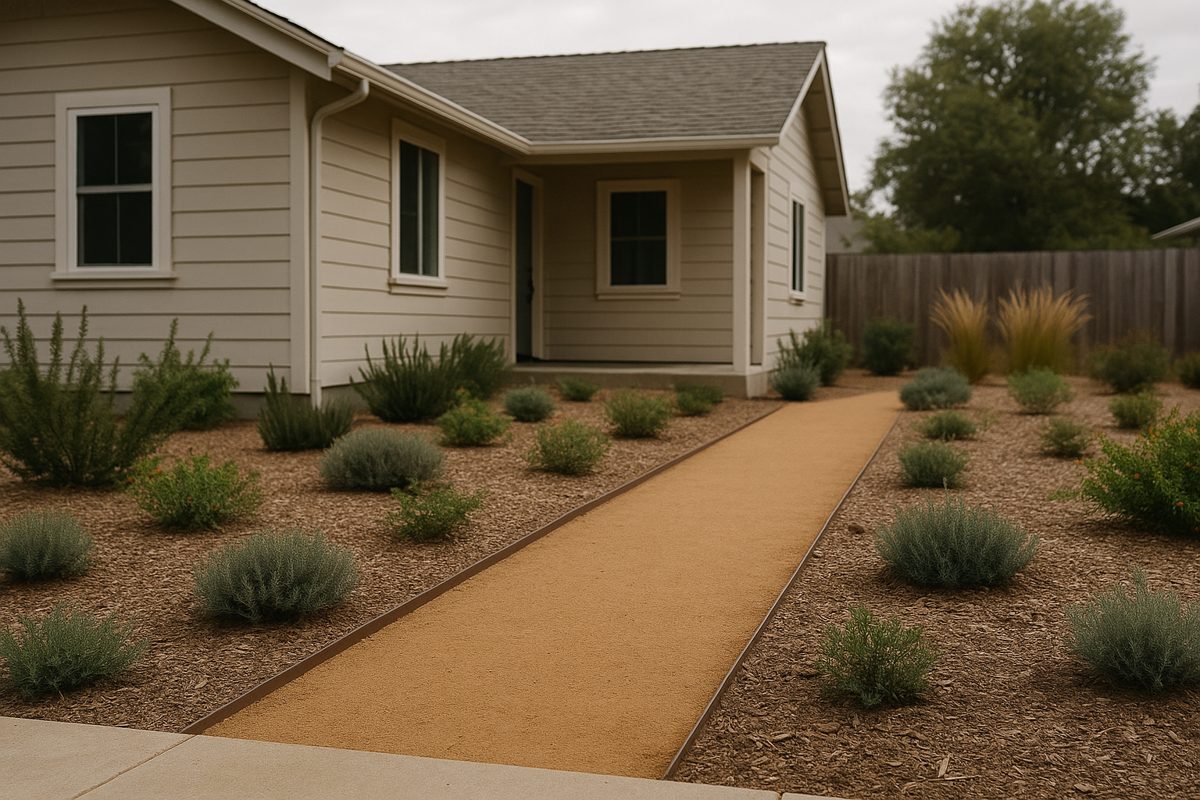
Granite weathered into grit and fines, compacted into a firm path. Known as DG in the US and Australia; it works like the self-binding gravel in 8.2.
At a glance
- Difficulty
- 2 of 4
- Time
- 1–2 days for 10 m of path
- Tools
- Spade, wheelbarrow, rake, plate compactor or roller, hose with a spray nozzle, string line
- Parts
-
- 1 Base
- 2 Granite fines
What you need per m²
| Material | Size | Type | Amount |
|---|---|---|---|
| Base | 0–32 mm | Crushed, with fines, 100 mm (3.1) | 230 kg |
| Decomposed granite | 0–8 mm | Granite fines with 6–15 % dust, 100 mm | 230 kg |
| Geotextile | – | Non-woven, where the ground is soft | 1 m² + overlaps |
Why plain or stabilized?
Granite fines that bind on their own fines when compacted. Cheap and easy to patch, but the surface loosens with use and washes out where water runs over it. Rake and top it up.
The same fines with a binder mixed in before compacting. Firmer and longer-lasting, and stays firm for wheelchairs across its width, but costs more and is harder to repair. It still fails where water runs along it.
What it is trail grading
Decomposed granite (DG) is granite that has weathered into coarse sand and grit: the loose, gritty layer at the foot of granite outcrops. Crushed and screened, it is sold as a 0–10 mm mix of grit and dust. It behaves like the self-binding gravel in 8.2: the dust binds the grit when it is compacted damp. Fines from granite or another hard stone work best. In the trail guidance the size is 3⁄8 in minus (0–9.5 mm); 0–8 mm is the nearest common EN size.
| Sieve | Passing, % |
|---|---|
| 9.5 mm (3⁄8 in) | 100 |
| 4.75 mm (No. 4) | 90–100 |
| 2.36 mm (No. 8) | 55–80 |
| 1.18 mm (No. 16) | 40–70 |
| 0.6 mm (No. 30) | 25–50 |
| 0.075 mm (No. 200) | 6–15 |
Step by step
-
1
Dig out the path.
About 200 mm deep for both layers, slightly wider than the path. Keep machines and compaction away from tree roots: do not dig or compact around the base of trees.
The dug-out bed -
2
Set the edging.
A fixed edge holds the fines in (8.5). Finish the surface level with or just above it so water can run off; an edge that stands proud dams the water on the path.
The edge -
3
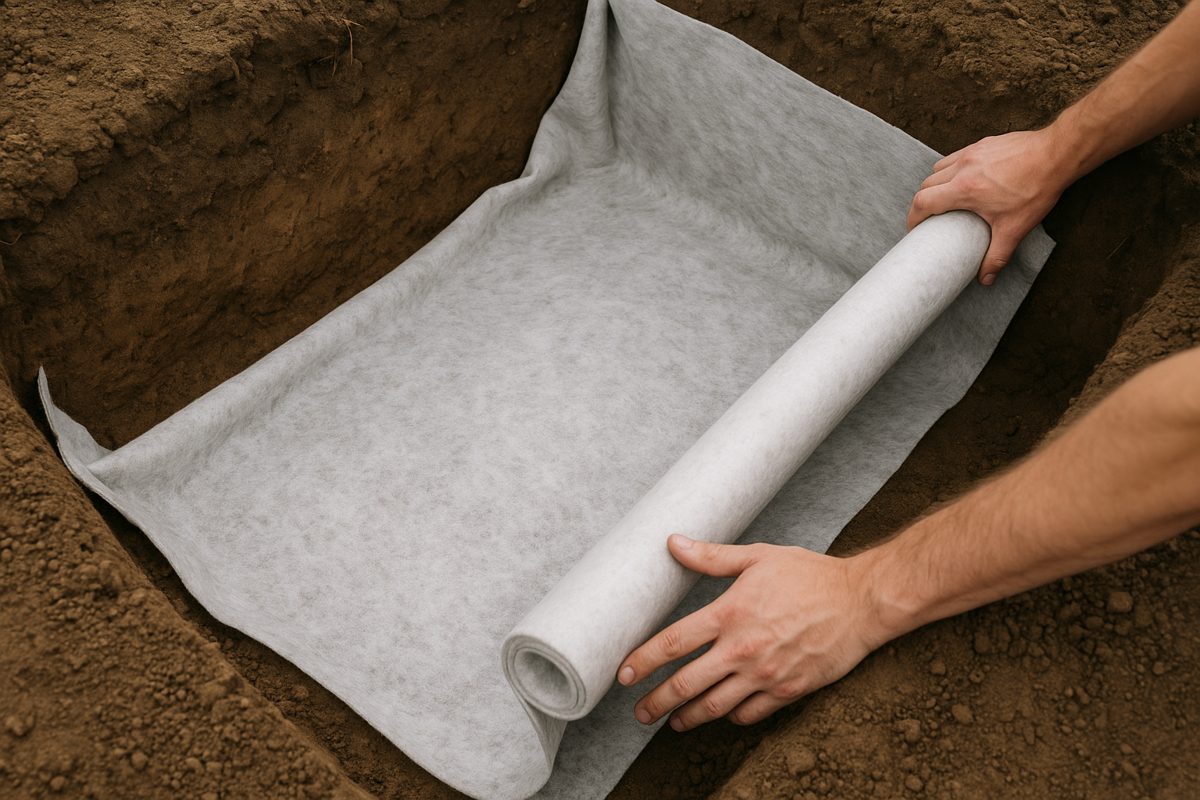
Lay a geotextile if the ground is soft.
It stops the soil being pushed up into the gravel when you compact.
Geotextile in the bed Illustration -
4
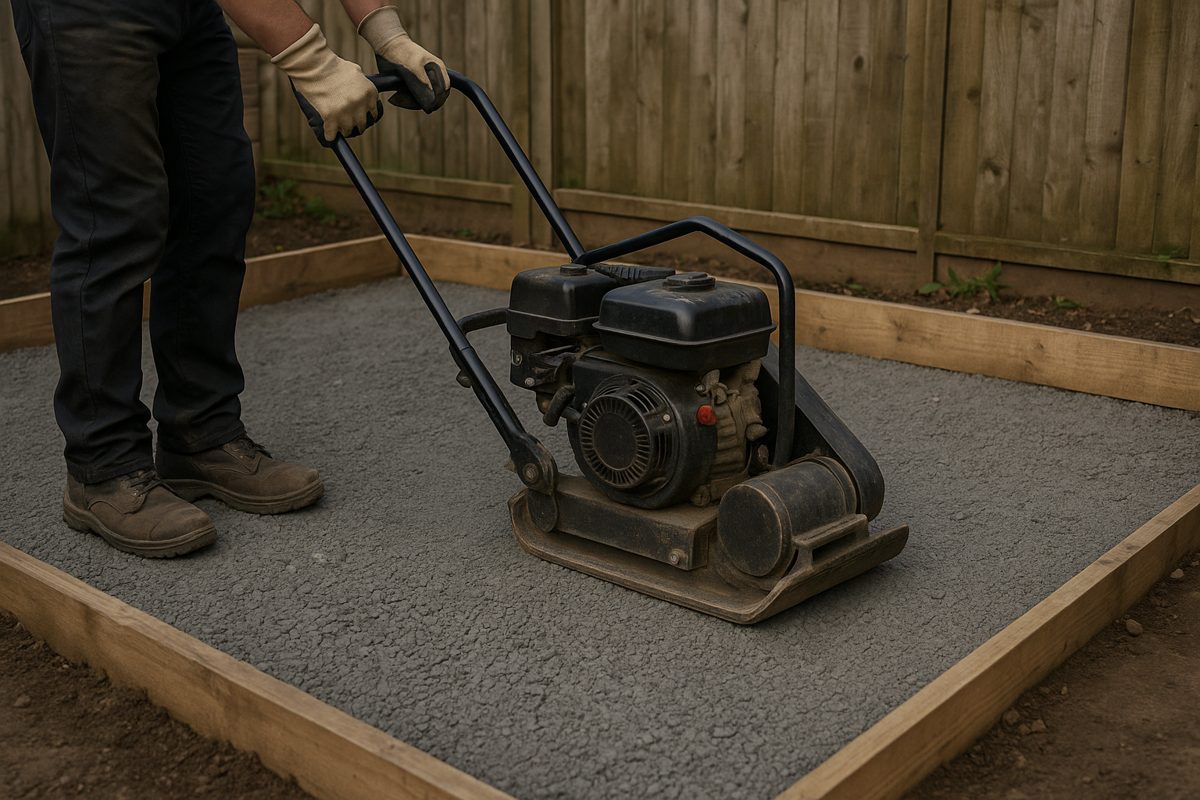
Lay and compact the base to the fall.
100 mm of 0–32 (3.1). Shape it to the final crown or side fall now, at least 2 %.
Compacting the base Illustration -
5
Dampen the fines and spread them.
At about 4–5 % water they hold together when squeezed. Spread them about half as thick again as the finished layer: trail guidance spreads 7–8 in for 5 in compacted.
Damp fines -
6
Compact to a 2 % crown or fall.
Use a roller or plate compactor. Layers over 100 mm go down in two. The finished surface should have no stones over 20 mm.
The crowned surface -
7
Let it dry.
It binds as it dries. Keep spare fines from the same source for patches.
A patched spot
Specifications
| Part | Sieve size | Thickness | How |
|---|---|---|---|
| 1 Base | 0–32 mm | 100 mm | Compacted, shaped to the final fall (3.1). |
| 2 DG | 0–8 mm (0–9.5) | 100–125 mm | 6–15 % fines, 4–5 % water, compacted. Brisbane: 100 mm stabilized. |
| Cross fall | – | 2 % | Crown or side fall. Brisbane: at least 1:50. |
| Grade | – | under 5 % | Never over 8 %. |
Thickness
US Forest Service trail guidance: fines laid 4–5 in (100–125 mm) deep bind into a consolidated slab; spread 7–8 in for 5 in compacted. Brisbane City Council's standard path: 100 mm of stabilized DG on a compacted gravel subbase, with about 30 mm of DG raked evenly over it before compaction, compacted to 95 % of maximum dry density.
Stabilizers
Lime or other binders can be mixed in. A Forest Service trial of stabilizers on accessible trails found a pine-resin emulsion performed best, with bentonite clay at 3 % by dry weight among the others tested. A Massachusetts trail matrix notes stabilized surfaces cost more up front and can fail quickly under concentrated water flow. This handbook names no products.
Accessibility
For an accessible route the surface must be firm and stable, with a cross slope of at most 2–3 %. Crushed rock with a full range of sizes, including fines, is preferred over uncrushed gravel.
Sources
- US National Park Service, City of Rocks National Reserve: geological trail station 1: “The detrital material (granitic sand) that is found at the base of most outcrops is called grus”, formed by granular disintegration of the rock
- Building crusher fines trails (L. Bachensky, USDA Forest Service, via American Trails, 2019): crusher fines 3⁄8 in minus, grading 100 % passing 3⁄8 in to 6–15 % passing No. 200; “Fines from granite or other suitable hard stone works best”; 4–5 in deep; spread 7–8 in for 5 in compacted; 4–5 % water; crowned or outsloped at 2 %; grades under 5 %, never over 8 %; geotextile on poor soils; lime or other stabilisers; stockpile fines from the same rock source
- Brisbane City Council, standard drawing BSD-5213: decomposed granite path (2024): 100 mm stabilised DG on a compacted sub-base; about 30 mm of DG raked evenly; no stones over 20 mm in the finished surface; crossfall at least 1:50; geotextile where fines could be pushed into the gravel; avoid compaction around trees
- USDA Forest Service, Soil stabilizers on universally accessible trails (R. Bergmann, 2000): stabiliser trial on an accessible trail; bentonite 3 % by dry weight; a pine-resin emulsion performed best; surfaces must be firm, stable and slip-resistant
- Commonwealth of Massachusetts, Trails for All, appendix B: trail surfacing matrix: crushed stone with fines is firm when built and maintained, but erodes under concentrated flow and its edges soften; stabilised surfaces cost more up front and can fail under concentrated water flow
- USDA Forest Service, Accessibility Guidebook for Outdoor Recreation and Trails (outdoor recreation access routes): surface “must be firm and stable”; cross slope at most 1:33 (3 %), 1:48 on paved surfaces; “Crushed rock (rather than uncrushed gravel)”
- Paths for All and Scottish Natural Heritage, Lowland Path Construction Guide (2019): granite dust is free-draining and less prone to frost heave than whin dust
- FHWA-RD-97-148, Granular base: natural aggregates weigh about 2.0–2.3 t/m³ in place
Amounts: compacted base and surface gravel at about 2.3 t per m³, the top of the 2.0–2.3 t/m³ that FHWA gives for natural aggregate in place, so they err on the generous side; loose stone and bedding sand at about 1.6 t/m³ (Penn State course notes give 1,520–1,680 kg/m³ for aggregate). No waste is included; order a little extra. The sources give the size as 3⁄8 in minus, about 0–10 mm.
GLAREUM.NET · Aggregate Handbook