8.6 Steps and slopes on paths
How steep a gravel path can be before it washes out, and how to build simple steps of stone or timber filled with gravel where it is steeper.
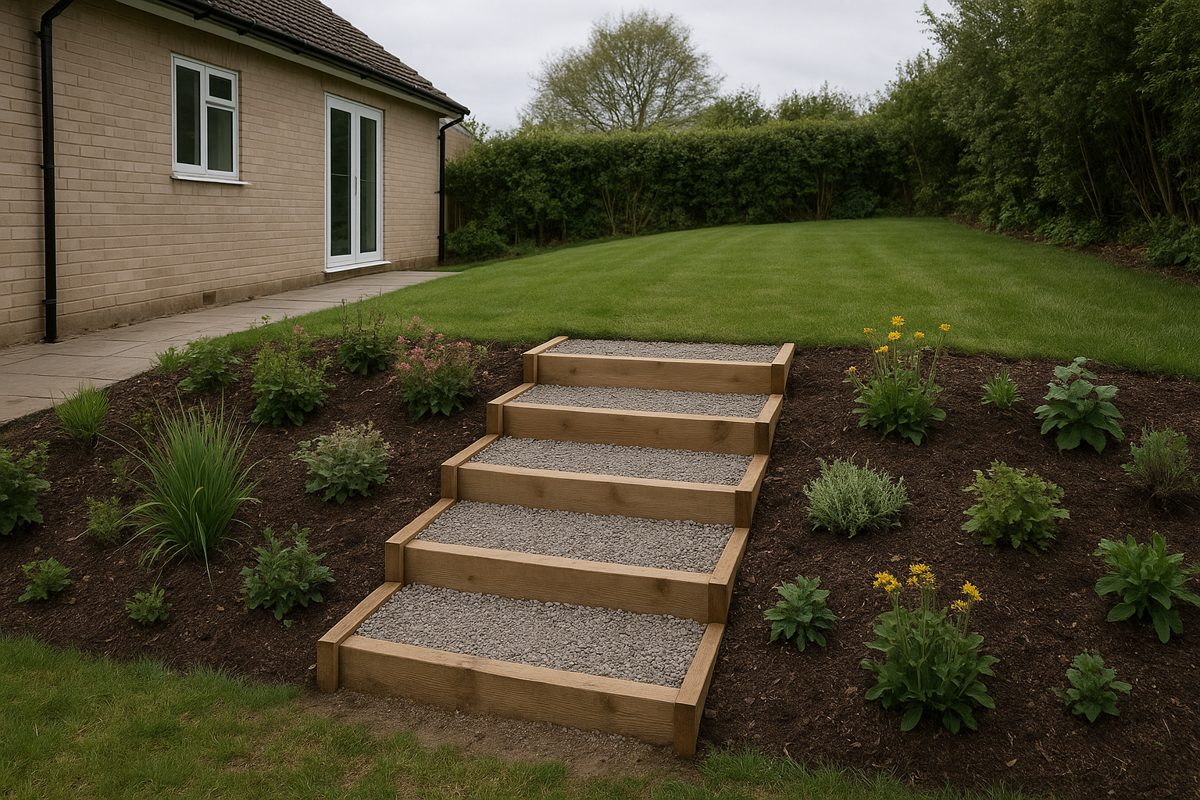
At a glance
- Difficulty
- 3 of 4
- Time
- 1 day for 5 steps
- Tools
- Spade, mattock, tape, carpenter's level, string line, hand tamper, sledgehammer, drill for pins
- Parts
-
- 1 Footing
- 2 Fill
- 3 Tread
How steep
| Slope | Ratio | What to build |
|---|---|---|
| up to 5 % | 1:20 | Any path in this chapter. |
| 5–8 % | 1:20–1:12 | Self-binding gravel or DG (8.2, 8.3) in short lengths, with level rests; not loose gravel. |
| 8–10 % | 1:12–1:10 | Very short lengths, or paving. Gravel washes out. |
| over 10 % | steeper than 1:10 | Steps, or a path that zigzags across the slope. |
Cross fall: about 2 %, and at most 1 in 40 (2.5 %) on the path to a front door. Measure the slope as height ÷ length × 100.
What you need per step, 1 m wide
| Material | Size | Type | Amount |
|---|---|---|---|
| Footing | 0–32 mm | Crushed, with fines, tamped | 0.02 m³ |
| Fill behind the riser | 0–32 mm | Crushed, with fines, tamped in layers | 0.05 m³ |
| Tread surface | 0–8 or 0–11 mm | Self-binding gravel (8.2), 50 mm | 35 kg |
| Riser | – | Large flat stone, sleeper or treated timber, with pins | 1 |
Why easy steps or trail steps?
Garden and house steps. UK guidance for the path to a front door: rise 75–150 mm, going (tread depth) at least 280 mm. Easy for everyone, so use these near the house.
Trail steps on steep ground. US Forest Service: rise 150–200 mm, tread 250–300 mm, and twice the rise plus the tread about 635–686 mm.
Step by step
-
1
Measure the height and length of the slope.
Divide the height by about 150 mm for the number of steps; divide the length by the number of steps for the tread. Check: twice the rise plus the tread should come to about 635–686 mm. If the treads come out very long, make them landings with a gentle slope.
Measuring the slope -
2
Start at the bottom.
Begin at a break in the slope, on firm ground. Dig a footing for the first riser and bury it well: it anchors everything above it.
The first riser dug in -
3
Set each riser on the one below.
Stone: the largest, squarest pieces you can move, each bearing firmly on the step below and the footing. Timber: pin each riser to the footing and to the step below. Keep every rise the same.
Risers stacked up the slope -
4
Fill and tamp each tread.
Fill behind the riser with 0–32 in thin layers, tamping each. Top with 50 mm of self-binding gravel (8.2) and compact.
Tamping a tread -
5
Tilt each tread to shed water.
Give each tread a slight crown or a tilt to one side. Water must not run far down the steps or collect on a landing.
A tread shedding water -
6
Turn the water off above the steps.
At the top, make a short dip or a bar across the path at an angle of 45–60°, so water runs off to the side instead of down the steps.
A drain bar above the steps
Specifications
| Part | Value | Source | Note |
|---|---|---|---|
| Rise, easy | 75–150 mm | Approved Document M | Path to a front door; uniform. |
| Going, easy | at least 280 mm | Approved Document M | Measured front to back. |
| Rise, trail | 150–200 mm | USDA Forest Service | |
| Tread, trail | 250–300 mm | USDA Forest Service | 254–305 mm in the source. |
| 2 × rise + tread | 635–686 mm | USDA Forest Service | Comfort rule. |
| Flight rise | max 1.8 m | Approved Document M | Between landings; landings at least 900 mm long. |
| Handrail | 3+ risers | Approved Document M | One side, 850–1000 mm above the pitch line. |
| Drain bar angle | 45–60° | USDA Forest Service | To the path; mostly useless over 20 % grade. |
Slopes
US Forest Service access routes: up to 1:20 (5 %) any length; 1:20–1:12 for at most 15 m between rests; 1:12–1:10 for at most 9 m; never over 1:10; rests at least 1.5 m long. Trail guidance for crusher fines: under 5 % where possible, never over 8 %. A US conservation standard keeps general walkways under 10 %. UK guidance: gravel is not suitable on steep drives, and permeable surfacing may not suit slopes over 1 in 20.
Water on slopes
Trail guidance turns water off the path with grade reversals every 6–15 m, each 3–5 m long, or with drain bars set at 45–60° to the path, buried two-thirds deep and running at least 300 mm into the bank.
Sources
- USDA Forest Service, Trail Construction and Maintenance Notebook: steps: rise about 150–200 mm, run 254–305 mm; twice the riser plus the tread 635–686 mm; build from the bottom at a break in grade; “Bury the first rock; it will act as an anchor”; pin timber steps; tamp the fill; crown or tilt each step; a grade reversal or drain dip at the top of the steps
- UK Government, Approved Document M, volume 1: dwellings (2015, with 2016 amendments): approach route at least 900 mm wide with a cross fall of at most 1 in 40; stepped approach with uniform rise 75–150 mm and going at least 280 mm; no flight rising more than 1800 mm; landings at least 900 mm long; a handrail on flights of three or more risers, 850–1000 mm above the pitch line
- USDA Forest Service, Accessibility Guidebook for Outdoor Recreation and Trails (outdoor recreation access routes): running slope up to 1:20; 1:20–1:12 for at most 15 m and 1:12–1:10 for at most 9 m between resting intervals; never over 1:10; resting intervals at least 1,525 mm long; cross slope at most 3 %
- USDA Forest Service, Trail Construction and Maintenance Notebook: surface water control: grade reversals 3–5 m long every 6–15 m; waterbars at 45–60° to the trail, two-thirds buried, at least 300 mm into the bank; “Waterbars are mostly useless for grades steeper than 20 percent”
- Building crusher fines trails (L. Bachensky, USDA Forest Service, via American Trails, 2019): crusher fines trails under 5 % where possible, never over 8 %
- USDA NRCS Vermont, Conservation Practice Standard 575: Trails and walkways (2021): general pedestrian trails “should generally not exceed 10 percent”
- UK Government (MHCLG and Environment Agency), Guidance on the permeable surfacing of front gardens (2009): gravel “Not suitable on steeply sloping drives”; permeable surfacing may not suit drives steeper than 1 in 20
- Paths for All and Scottish Natural Heritage, Lowland Path Construction Guide (2019): a path may meander or zigzag up steep slopes to reduce the gradient
Amounts: rough volumes for a step 1 m wide with a 150 mm rise and 350 mm tread; tread gravel at about 2.0 t/m³ as in 8.2. The slope table groups the sources above. The 150 mm rise in the worked rule sits where the two step types meet.
GLAREUM.NET · Aggregate Handbook