10.1 Filling and leveling with soil
Raising a low garden, filling a hollow or leveling uneven ground with soil, where only grass or plants go on top.
At a glance
- Difficulty
- 2 of 4
- Time
- 1 day per 10 m³ by hand
- Tools
- Spade, wheelbarrow, rake, hand tamper or plate compactor, pegs, string line, carpenter's level, tarps for heaps
- Parts
-
- 1 Undisturbed ground
- 2 Subsoil fill in layers
- 3 Topsoil on top
- 4 Clearance at the wall
What you need per m², per 100 mm of fill
| Material | Kind | Type | Amount |
|---|---|---|---|
| Fill | Subsoil or clean soil | No sod, roots, wood, rubble or rubbish | 0.1 m³ |
| Topsoil | Loam or sandy loam | Only the top layer: 150 mm under lawn | 0.15 m³ |
| By weight | Loose soil | About 1.4 t per m³ | 140 kg |
Why subsoil below, topsoil on top?
Topsoil is the living top layer, with about 2–10 % organic matter. Roots need it, but only near the surface: 150 mm for a lawn, up to 400 mm for shrubs and trees.
Deeper fill should be subsoil. It has little organic matter, so there is little to rot away and settle.
Sod, stumps, branches and rubbish rot. They leave holes, and the ground above sinks.
Soil fill is for gardens. Under a patio, a shed or a slab use crushed stone fill (2.3) instead.
Step by step
-
1
Strip the sod and topsoil.
Lift the sod and dig off the topsoil over the whole area to be raised. Keep the topsoil in its own heap, apart from the subsoil.
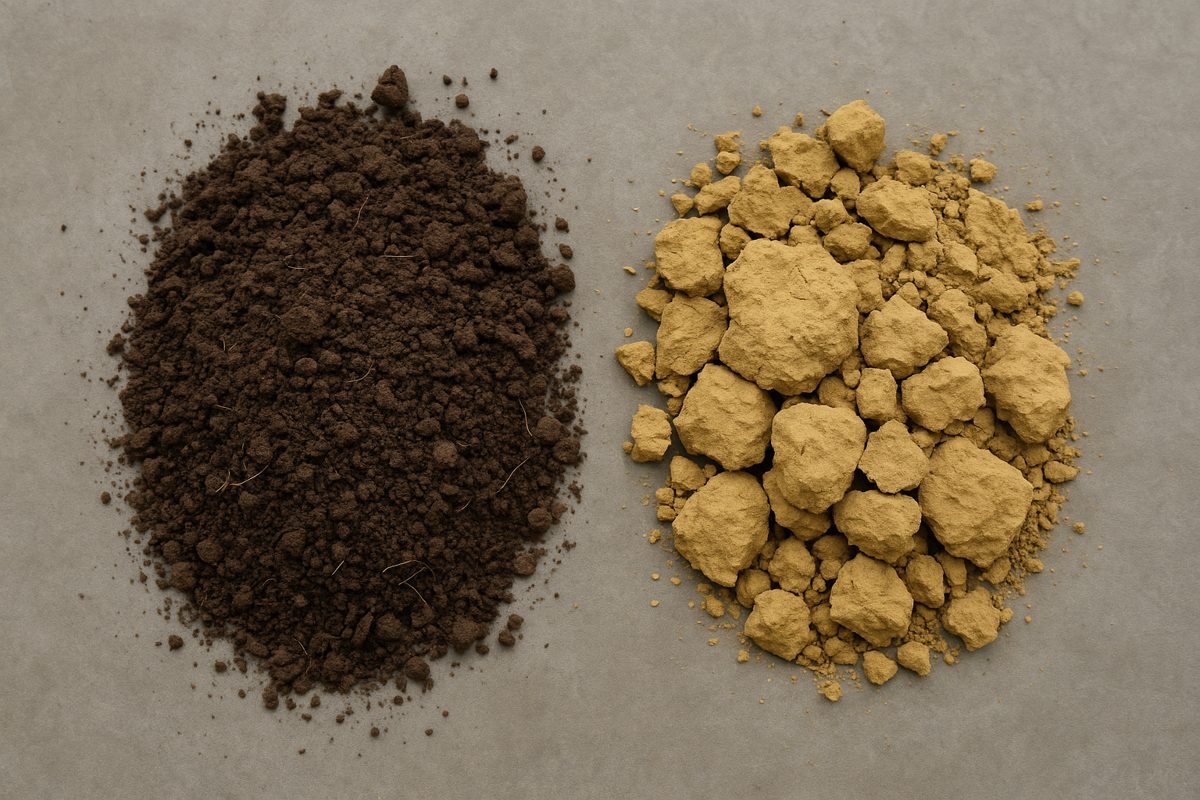
Separate heaps of topsoil and subsoil Illustration -
2
Fill with subsoil in thin layers.
Spread the fill a few centimeters at a time and tamp each layer firm before the next. Work only when the soil is dry or just moist, never when it is sticky.
Tamping a layer of fill -
3
Shape the fall away from buildings.
Next to a house, let the finished ground fall at least 150 mm over the first 3 m away from the wall. Keep it at least 150 mm below the damp-proof course or the bottom of wooden cladding.
String line showing the fall from the wall -
4
Loosen the top and spread topsoil.
Fork over the top of the firmed subsoil so roots and water can get into it. Then spread the topsoil back: 150 mm under a lawn, up to 400 mm where shrubs and trees will grow.
Topsoil raked over the fill -
5
Let it settle, then top up.
Mound filled hollows slightly above the final level, because fill settles. Leave the ground to settle, ideally five to six weeks before sowing, and fill any dips that appear.
Slight dome over a filled hollow
Specifications
| Part | Kind | Value | Note |
|---|---|---|---|
| Topsoil, lawn | Loam | 150 mm | Defra code; Penn State 100–150 mm settled. |
| Topsoil, shrubs and trees | Loam | up to 400 mm | Defra code. Deeper rooting depth is made with subsoil. |
| Fill layers | Subsoil | a few cm, tamped | Fairfax County. Engineered fill under buildings is placed in layers of at most 300 mm and tested; that is not DIY. |
| Fall from walls | – | 150 mm in 3 m (5 %) | US building code, as quoted by Maricopa County; US DOE asks for about 4 %. |
| Clearance | – | 150 mm | Below the damp-proof course (UK) or wooden siding (US). |
| Over tree roots | – | max 75 mm | Less on clay (University of Maryland). |
| Weight | Loose sandy loam | 1.4 t/m³ | US EPA: 2,392 lb per cubic yard. |
When to work
Move and spread soil only when it is dry or slightly moist. If it is wet and sticky, or it has just rained hard, let it dry first.
Heaps
Keep topsoil and subsoil in separate heaps and do not drive over soil once it is spread. Loosen compacted subsoil before the topsoil goes on.
Settling
Soil fill settles. Mound it slightly and top up later.
Sources
- Defra (UK), Construction code of practice for the sustainable use of soils on construction sites (2009): strip topsoil to the colour change; never stockpile topsoil and subsoil together; handle soil only when dry or slightly moist; no machines over placed soil; decompact subsoil before topsoil; topsoil at least 150 mm for lawns, up to 400 mm for trees and shrubs, deeper rooting depth made with subsoil
- University of Connecticut Home and Garden Education Center, Purchasing topsoil: topsoil is the uppermost layer of soil; it should have at least 2 % and no more than about 10 % organic matter
- Penn State Extension, Lawn establishment: grade the subsoil before the topsoil is replaced; at least 100–150 mm (4–6 in) of topsoil, firmed or settled
- Fairfax County Soil and Water Conservation District, Drainage problem: sinkhole: fill a few inches at a time and tamp each layer; mound the fill into a small dome because it settles; buried brush, stumps and debris rot and leave voids
- Seattle Building Code, Appendix J: grading: remove vegetation and topsoil before filling; no organic material in fill; no rock over 305 mm; engineered fill compacted to 90 % of maximum density
- Royal Horticultural Society, Lawns from seed: leave dug soil to settle, ideally five to six weeks, before sowing
- Maricopa County, Building elevation requirements (quoting the International Residential Code R401.3): the ground falls at least 152 mm (6 in) within the first 3,048 mm (10 ft) from the building
- US Department of Energy, Building Science Education: final grade sloped away from home: slope the final grade away from the house at least 0.5 in per foot (about 4 %) for 10 ft; tamp the soil to prevent settling
- Oak Ridge National Laboratory, Building foundation design handbook §4.1: 6 in drop in 10 ft; exterior wood siding and trim at least 6 in (150 mm) above grade
- UK Government, Approved Document C: frequently asked questions: damp-proof course at least 150 mm above ground level
- University of Maryland Extension, Grade change problems and trees: 75 mm (3 in) of soil is the most that can safely be added over tree roots, less for clay soil; clayey additions over 25 mm (1 in) cause low-oxygen problems
- UMass Amherst Urban Tree factsheet 17, Tree root damage: do not raise the grade over roots more than a few inches; most roots lie in the top 150–450 mm (6–18 in)
- US EPA, Volume-to-weight conversion factors: loose soil or sandy loam: 2,392 lb per cubic yard, about 1.42 t/m³
Amounts: 1 m² × 100 mm = 0.1 m³ of fill, or about 140 kg of loose soil at 1.42 t/m³. Order extra for settling.
GLAREUM.NET · Aggregate Handbook