8.5 Path edging and weed control
What keeps gravel in the path and weeds out of it: a firm edge, a separating layer underneath, a compact surface and steady use.
At a glance
- Difficulty
- 1 of 4
- Time
- Half a day for 10 m of edge
- Tools
- String line, spade, rubber mallet, hacksaw or snips, half-moon edger, hoe
- Parts
-
- 1 Geotextile
- 2 Edge
- 3 Surface
What you need per m of path
| Material | Size | Type | Amount |
|---|---|---|---|
| Steel or aluminum edge strip | – | About 8 × 150 mm, with pins | 2 m |
| Recycled plastic edge | – | Board or strip, with pegs | 2 m |
| Geotextile | – | Non-woven, full width + overlaps | 1 m |
Why a soft edge or a fixed edge?
The base runs a little wider than the surface and the sod grows over its edge. The preferred edge for countryside paths: nothing to rot, nothing to trip on. Needs regular edge cutting. Not for loose gravel, which spreads.
A steel, aluminum, plastic or concrete edge set to the line. Holds loose gravel and keeps a crisp line. Timber boards rot and need replacing, so steel or recycled plastic lasts longer.
Step by step
-
1
Choose the edge.
Soft sod edge for self-binding gravel and DG beside a lawn. Fixed edge for loose gravel, for paths beside beds, and wherever you want a crisp line.
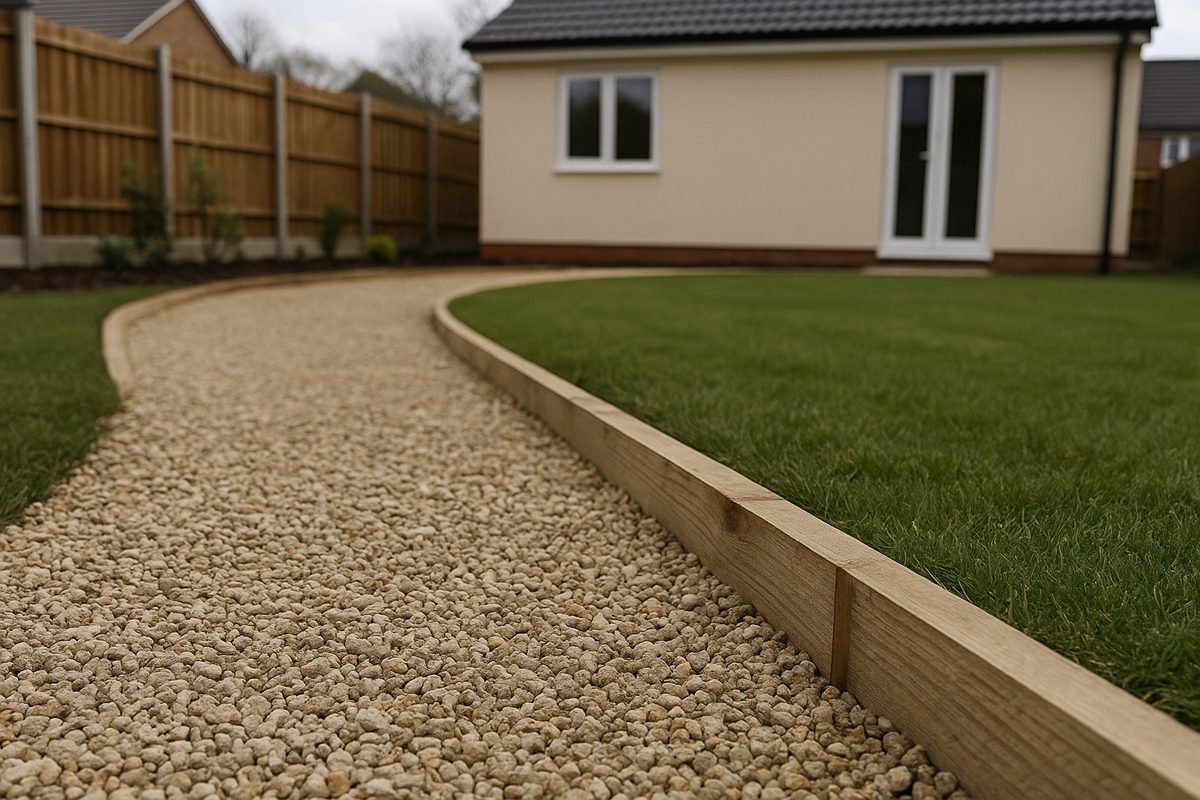
A steel edge beside a lawn -
2
Set the edge before the base goes in.
Run a string line at the finished height. Drive the edge in or peg it so its top is level with, or just below, the finished surface, never above it, or it traps water on the path.
The edge set to the line -
3
Lay the geotextile.
Across the bottom of the dig and up to the edges, with generous overlaps. It keeps soil from mixing into the stone and slows weeds from below.
Geotextile laid in the bed -
4
Build the path tight against the edge.
Compact the base and surface right up to the edge (8.1–8.3), so nothing loose is left along it for seeds to germinate in.
Compacting along the edge -
5
Cut the sod edge late in the season.
A soft edge needs cutting to keep its line. The later in the growing season you cut, the longer the sharp edge lasts. Put back any gravel you remove so the path level does not drop.
Cutting the edge -
6
Keep weeds down by use and by hand.
A well-compacted, well-used path gets few weeds. Hoe, pull or burn them while small. On bound gravel, do not use tools that loosen the surface deeply.
Weeds at the path edge
Specifications
| Edge | Lasts | Suits | Note |
|---|---|---|---|
| Sod, base wider than surface | As long as it is cut | 8.2, 8.3 | Paths for All's preferred option. |
| Steel strip 8 × 150 mm | Long | All | Used in the Frederiksberg Have trial. Iron pins as an alternative. |
| Recycled plastic | Long | All | Paths for All's suggestion instead of timber. |
| Timber boards | Needs replacing | All | Paths for All advise against it. |
| Precast concrete, metal, plastic, wood | Long | Slab paths (8.4) | Edge restraints for pavers (OSU). Driveway edges: 7.8. |
Geotextile
It separates fine, soft soil from the stone above, so the stone does not sink and the soil does not pump up. The US Forest Service calls separation the main job. A US conservation standard puts one under all gravel walkways; Scottish guidance says firm, well-drained ground on light-use paths usually does without.
Weeds without chemicals
Danish park guidance: densely compacted gravel lets little grow in from the sides; seeds germinate in loose material along the edges. Wear, burning (thermal methods), brushing, dragging, raking and shallow harrowing all work; a thicker wearing layer and narrower paths reduce weeds. This handbook does not cover herbicides.
Sources
- Paths for All and Scottish Natural Heritage, Lowland Path Construction Guide (2019): “It is essential to support path edges to prevent lateral spread of the base layer”; preferred edge is a base wider than the surface with turf as a soft edge; avoid timber edging, which needs periodic replacement, and consider recycled plastic; finish the surface above the edge so water runs off
- Danish Palaces and Properties Agency (Slots- og Ejendomsstyrelsen) with the University of Copenhagen, Opbygning af befæstelser: gravel paths in Frederiksberg Have (2003): trial edges with iron spikes or 8 × 150 mm iron edge strip; weeds controlled by burning, brushing, dragging, raking and hand; a thick wearing layer and narrower paths reduce weeds
- University of Copenhagen, maintenance guide for self-binding gravel (2013): seeds germinate in loose material along the edge; wear and thermal methods; edge cutting against grass, the later in the season the longer the profile lasts; refill removed gravel
- University of Copenhagen, Department of Geosciences and Natural Resource Management (IGN): specification for a self-binding path gravel: densely compacted gravel gives little ingrowth from the sides; avoid tools that loosen deeply
- USDA Forest Service, Trail Construction and Maintenance Notebook: geosynthetics: geotextiles “separate the silty, mucky soil beneath the fabric from the mineral, coarse-grained, or granular soil”; “The importance of separation cannot be overemphasized”
- USDA NRCS Vermont, Conservation Practice Standard 575: Trails and walkways (2021): a geotextile or other approved underlayment on all gravel trails and walkways
- UF/IFAS Extension Manatee County, Master Gardener: Down the garden path (2019): “Putting landscape fabric down first helps prevent weeds from growing through the path”; edging keeps loose materials in place
- University of Florida IFAS Extension, Gardening Solutions: walkways in the landscape: “Loose materials like mulch and gravel will need edging”
- Oregon State University Extension, 10-step guide to installing pavers: edge restraints of plastic, precast concrete, metal or wood
Amounts are per metre of path with edges on both sides. The edge height follows Paths for All (surface above the edge) and the Copenhagen maintenance guide (surface a little above the ground beside it).
GLAREUM.NET · Aggregate Handbook