6.5 Soakaway
A pit filled with clean stone that holds rainwater from a roof or a paved area and lets it seep slowly into the ground.
At a glance
- Difficulty
- 3 of 4
- Used for
- Roof water from a shed, garage or extension; water from a patio or drive; the outlet of a drainage trench (6.4)
- Tools
- Spade or mini excavator, tape measure, stopwatch, bucket or hose, wheelbarrow
- Parts
-
- 1 Silt trap
- 2 Soakaway stone
- 3 Geotextile
- 4 Soil cover
What you need per m³ of pit
| Material | Size | Type | Amount |
|---|---|---|---|
| Soakaway stone | 32–63 mm | Washed, single size | 1.5 t |
| or | 16–32 mm | Washed, single size | |
| Geotextile | – | Non-woven, on the sides and top | 5 m² for a 1 m cube |
| Silt trap | – | Catch pit or gully with a removable bucket | 1 |
Why voids matter
Only the gaps between the stones hold water. Washed single-size stone is about 40 % gaps. Mixed rubble or graded fill is about 30 %, so the pit must be a third bigger.
Fines fill the gaps and clog the soil walls. A soakaway needs washed stone with no fines, and a silt trap so the roof does not wash dirt in.
Test the soil first
How fast the ground takes water decides everything. The standard test (BRE Digest 365) is simple:
- Dig a test pit as deep as the planned soakaway, 0.3–1 m wide and 1–3 m long, with straight sides.
- Fill it with water and time how long the level takes to fall from 75 % to 25 % of the depth.
- Do it three times, on the same day or the next days. Use the slowest result.
- Infiltration rate = water volume between 75 % and 25 % ÷ (wetted area of base and sides at half depth × the time).
If the pit hardly drains, as in clay or chalk, a soakaway will not work. Ask a geotechnical engineer, or lead the water elsewhere.
Rough pit size
Uses one local authority's simple rule for small roofs: store the water from about 16.7 mm of rain (area × 50 ÷ 3,000), divided by the share of voids. It ignores what soaks away during the storm, so it errs on the large side. For larger areas, use the soil test and the BRE 365 method.
Step by step
-
1
Pick a spot at least 5 m from any building.
Also keep 2.5 m from the boundary and away from roads. The highest groundwater level should be at least 1 m below the bottom of the pit.
Measuring the distance from the house -
2
Test the soil and size the pit.
Use the test above. Half the stored water should drain away within 24 hours.
Test pit filled with water -
3
Dig the pit and line the sides with geotextile.
Leave the bottom open so water can soak out. Overlap fabric joins by about 300 mm.
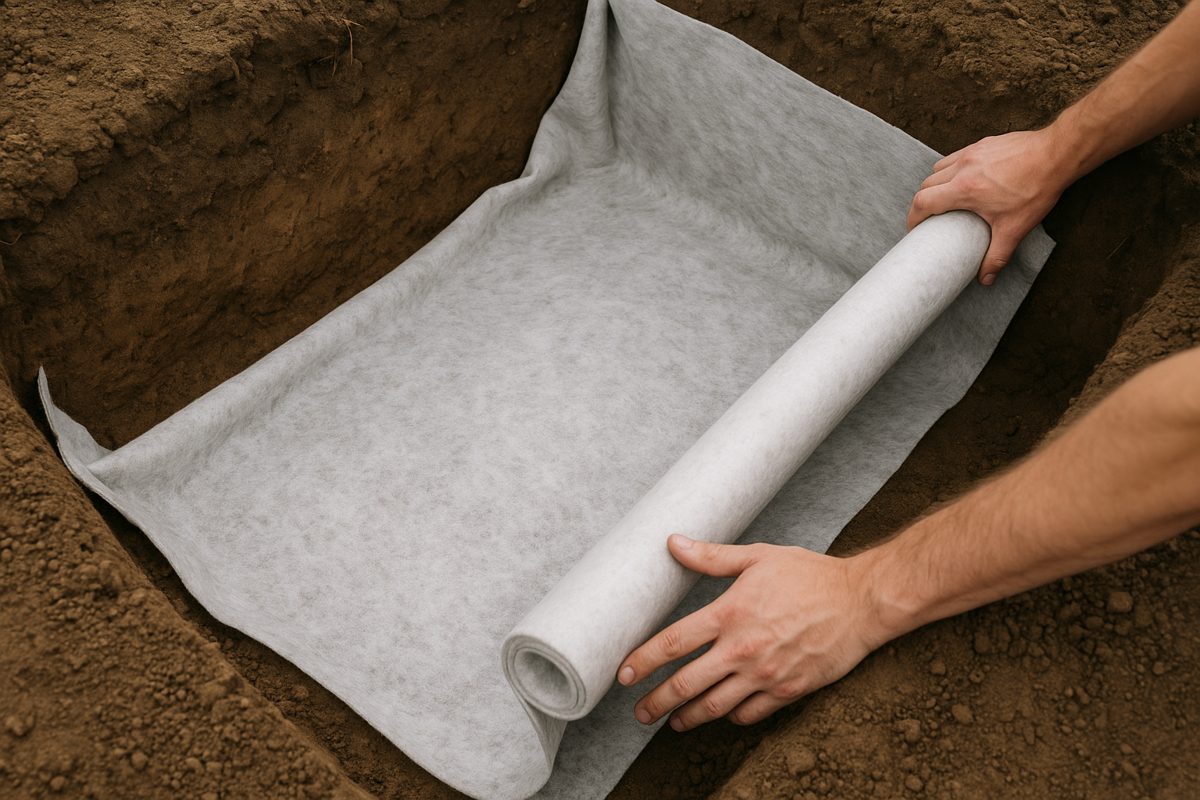
Fabric on the pit walls Illustration -
4
Fill with washed stone and bring in the pipe through a silt trap.
The silt trap catches leaves and grit before they reach the pit. Empty it now and then.
Inlet pipe entering the stone -
5
Fold the fabric over the top and cover with about 300 mm of soil.
The top cover stops soil washing down into the stone.
Fabric folded over, before the soil goes on
Specifications
| Part | Size | Value | Note |
|---|---|---|---|
| Stone | 32–63 mm or 16–32 mm | 40 % voids | Washed, uniform. Sources name 38–75 mm washed stone or clean pieces up to 150 mm. |
| Rubble | up to 150 mm | 30 % voids | Clean brick, block or concrete pieces. |
| Crates | – | 90–95 % voids | Plastic infiltration units. |
| Distance | 5 m from buildings, 2.5 m from boundary | UK councils. US guidance gives 10 ft (3 m) from foundations. | |
| Groundwater | 1 m below the base | Seasonal high level. | |
| Drain time | half empty in 24 h | BRE 365 design check. | |
| Soil cover | about 300 mm | US state guidance (12 in). | |
Sizing properly
Storage needed = rain falling on the area − water that soaks into the pit walls during the storm. Councils that use BRE 365 ask for a 1-in-10-year storm and, for homes, a safety factor of 2 on the soil's infiltration rate. Some add 30 % for climate change.
Stone size
Sources name washed stone of 38–75 mm, or clean pieces up to 150 mm. 32–63 mm is the nearest common metric size, and 16–32 mm also works.
Fabric
Non-woven geotextile on the sides and top, not the bottom. A plastic sheet or a thin concrete layer over the top also keeps soil out.
Sources
- West Devon Borough Council: infiltration testing (BRE Digest 365 method): pit “0.3 to 1 m wide and 1 to 3 m long”, “Repeat the test 3 times”, rate from the fall between 75 % and 25 %
- Runnymede Borough Council: surface water drainage guidance: “n = 0.3 is usually assumed for granular filled infiltration systems”, crates 0.9–0.95, safety factor 2 for homes, 1-in-10-year storm, half empty within 24 h, water table 1 m below
- CNC Building Control (council partnership): soakaway size for an extension: volume = area × 50 ÷ 3,000, voids about 30 %, pieces “no larger than 150mm”, “at least 5m from any building or road”
- Hastings Borough Council: soakaway advice note: “at least 5m away from any building”; water table at least 1 m below the base; specialist advice on clay and chalk
- Eden District Council: rainwater soakaway design guidance: not within 5 m of a building or road, or 2.5 m of a boundary
- Minnesota Stormwater Manual: infiltration media: double-washed uniform stone, 1.5–3 in, “void ratio of 0.40”; non-woven geotextile on sides and top, not the bottom; 12 in overlap
- Philadelphia Water: drainage wells checklist: porosity 0.40 for stone storage; traps before the well; 10 ft from buildings
- Connecticut Stormwater Manual (UConn): dry wells: wrapped in filter fabric, “covered by a minimum of 12 inches of soil”, 10 ft from foundations
- Government of Jersey, Guidance Note 3: surface water: 1-in-10-year return period, 30 % climate allowance, silt trap before the soakaway
- FHWA-HRT-15-034, open-graded aggregates: loosest unit weight of clean No. 5 and No. 57 stone about 95 lb/ft³ (1.52–1.53 t/m³)
Amount: the pit is filled with stone, so stone volume ≈ pit volume. 1 m³ × 1.5 t/m³ ≈ 1.5 t, loose. Fabric for a 1 m cube: four sides plus the top, 5 m², plus overlaps.
GLAREUM.NET · Aggregate Handbook