2.1 Pipe and duct bedding
The bed under and the fill around buried drain pipes, cable ducts and water pipes. It carries the pipe evenly along its length and keeps hard points off it.
At a glance
- Difficulty
- 2 of 4
- Time
- 1 day for 10 m of trench, dug by hand
- Tools
- Spade or mini excavator, string line, carpenter's level or laser, rake, hand tamper
- Parts
-
- 1 Bed
- 2 Side fill and surround
- 3 Backfill
What you need per meter of trench, 110 mm pipe, 500 mm wide
| Material | Size | Type | Amount |
|---|---|---|---|
| Bed and surround | 2–8 mm | Rounded or crushed, washed | 0.17 m³ |
| or | 0–4 mm | Sand, for water pipes and cable ducts | |
| or | 8–16 mm | Drain pipes from DN 100, largest grain under 19 mm | |
| Backfill | dug soil | Stones, roots and lumps picked out | rest of trench |
Why fine gravel or sand?
Small grains run in under the curve of the pipe and leave no hard points. Washed means few fines, so the bed drains and does not turn to mud.
Sand packs closely around small pressure pipes and cable ducts. It is fine enough for the smallest pipes, where the largest grain allowed is 15 mm.
Allowed for drains from DN 100 up. EN 1610 caps the largest grain at 22 mm up to DN 200, and the US Bureau of Reclamation at 19 mm.
Step by step
-
1
Dig the trench to depth and width.
Dig about 400 mm wider than the pipe, so you can tamp beside it, and 100 mm deeper than its underside. In rock or hard ground, dig 150 mm deeper.
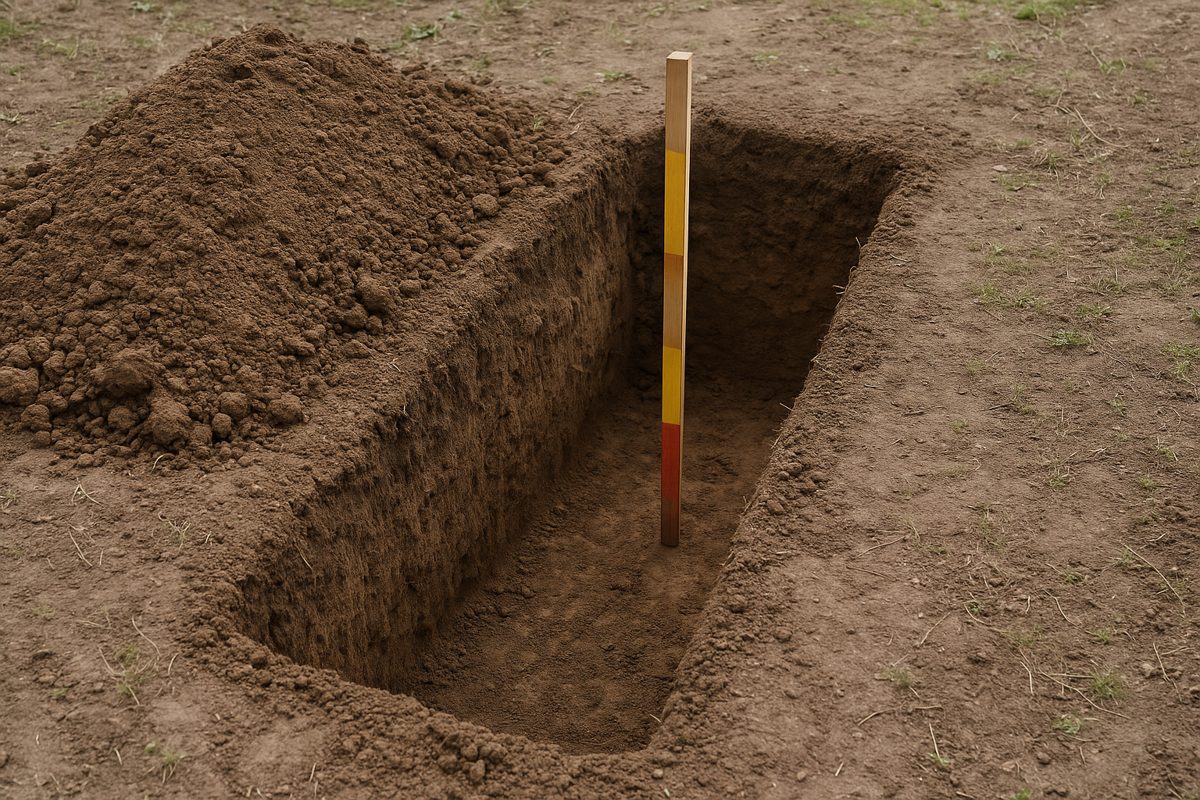
The trench with a depth rod Illustration -
2
Spread and level 100 mm of bed.
Rake it to the line and fall of the pipe. Pick out any stone that sticks up.
Raking the bed level -
3
Lay the pipe and check the fall.
The pipe should rest on the bed along its whole length. Pack bed under any low spot rather than propping the pipe on stones.
Checking the fall with a level -
4
Fill both sides and tamp by hand.
Bring both sides up together, never more than 150 mm apart, and work the fill in under the sides of the pipe.
Tamping beside the pipe -
5
Cover the pipe by 150 mm.
Use the same material as the bed. It protects the pipe from stones in the backfill.
The surround over the pipe -
6
Backfill the rest in layers.
Use dug soil without big stones and compact it as in 2.2. Keep heavy machines off until there is at least 750 mm over the pipe.
Backfilled trench
Specifications
| Part | Sieve size | Thickness | How |
|---|---|---|---|
| 1 Bed | 2–8 mm or 0–4 mm | 100 mm, 150 mm in rock | Raked to the line and fall. |
| 2 Side fill and surround | same as the bed | to 150 mm over the pipe | Both sides together, tamped by hand into the sides of the pipe. |
| 3 Backfill | dug soil | rest of the trench | In layers, see 2.2. Heavy machines only with 750 mm of cover. |
Largest grain
EN 1610 limits the bedding by pipe size: 15 mm below DN 100, 22 mm from DN 100 to DN 200 and 40 mm up to DN 600. The US Bureau of Reclamation asks for no more than 19 mm with at most 5 % fines. A washed 2–8 mm or 4–8 mm suits every size here.
Bed thickness
EN 1610 asks for at least 100 mm under the pipe in usual soil and 150 mm in rock or hard soil. US city details use the same 150 mm of washed stone in rock or wet soil.
Trench width
EN 1610 sets the minimum at the pipe's outside diameter plus 0.40 m up to DN 225. For a 110 mm pipe that is about 500 mm. The extra room is for tamping the sides.
Depth of cover
Local rules set how deep drains must lie. Where a pipe has to be shallower, it is protected with a concrete slab laid over at least 75 mm of granular fill. Water pipes also go below the local frost depth.
Sources
- EN 1610:2015 Construction and testing of drains and sewers: lower bedding at least 100 mm in usual soil and 150 mm in rock or hard soil (§7.2); minimum trench width OD + 0.40 m up to DN 225 (Table 1); stones in main backfill no bigger than half the compaction layer (§5)
- prEN 1610, official sample pages: largest grain in bedding 15 mm below DN 100, 22 mm for DN 100–200, 40 mm for DN 200–600 (§6.3.1)
- US Bureau of Reclamation, Pipe bedding and backfill (training manual 7): 100 mm bedding for pipes up to 250 mm, embedment stone up to 19 mm with 5 % or less fines, both sides raised together within 150 mm, compacted layers of at least 150 mm with tampers, 750 mm cover before heavy machines cross
- City of Hendersonville, sewer trench detail: bedding material to 150 mm above the top of the pipe; at least 150 mm of washed stone in rock or wet soil; sand around pressure pipes in 150 mm layers
- Approved Document H (UK government, 2015): at least 100 mm of granular fill round a pipe under a building (§2.23); shallow pipes protected by a concrete slab over at least 75 mm of granular fill (§2.44)
- US HUD / NAHB Research Center: Frost-Protected Shallow Foundations, Phase II: frost depth set mainly by winter air temperatures, with soil type, soil moisture, snow and ground cover
- Nova Scotia Community College: Water Service Protection and Maintenance: water services are buried below the frost line; where that is not possible they get freeze protection such as pre-insulated pipe or heat cable
- EN 13242 Aggregates for unbound and hydraulically bound materials
Amounts: trench 500 mm wide, filled from the trench bottom to 150 mm over a 110 mm pipe (360 mm), less the pipe itself: 0.17 m³ per metre, measured in place. Order a little extra.
GLAREUM.NET · Aggregate Handbook