7.9 Maintaining a gravel driveway
Fix potholes, ruts and washboarding, bring back the crown and top up the stone, on a loose (7.2) or a compacted (7.3) gravel drive.
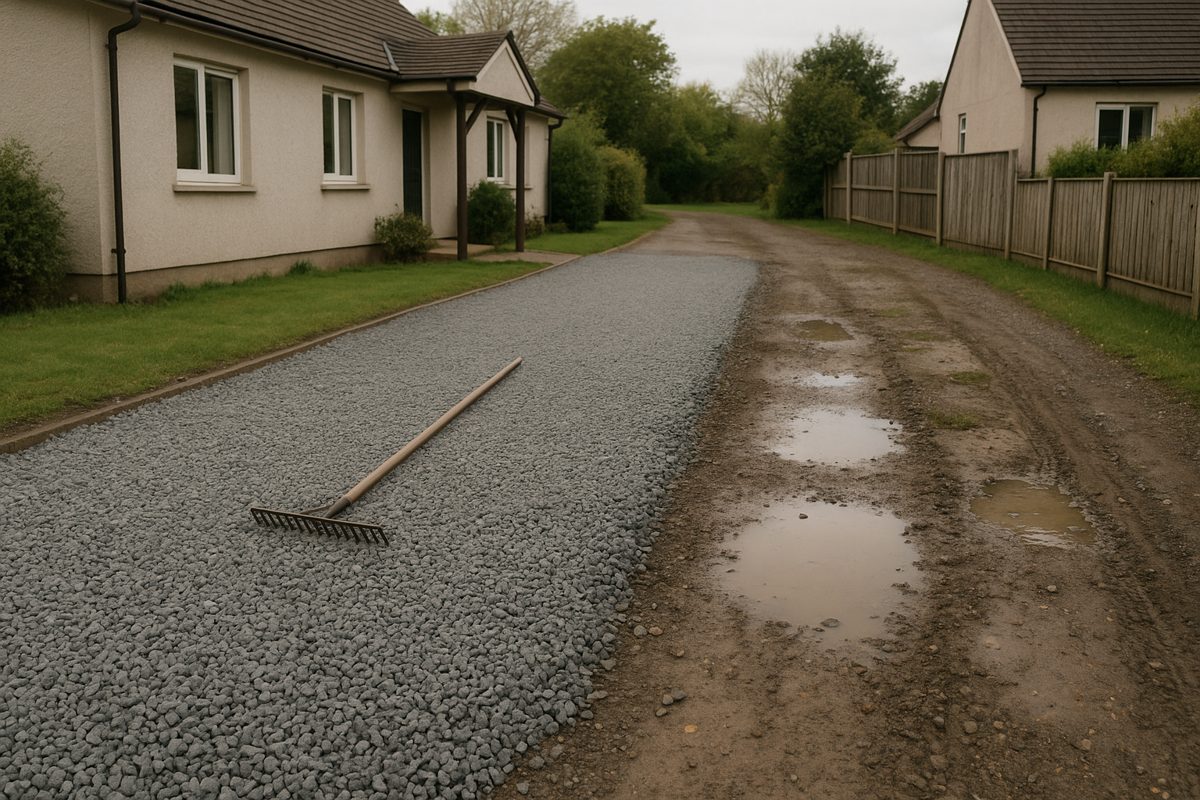
At a glance
- Difficulty
- 2 of 4
- Time
- Under an hour per pothole; 1 day to regrade 30 m²
- Tools
- Spade, steel rake, wheelbarrow, hand tamper or plate compactor, string line, carpenter's level, hose with a spray nozzle
- When
- Spring, and after a rain, when the stone is damp. Look it over again in autumn.
What you need per m²
| Material | Size | Type | Amount |
|---|---|---|---|
| New surface, compacted drive (7.3) | 0–16 mm | Crushed, with fines, 50–75 mm compacted | 115–175 kg |
| Top-up, loose drive (7.2) | 8–16 mm | Crushed, washed, no fines; example 20 mm layer | 30 kg |
| Deep potholes and ruts | 0–32 mm | Crushed, with fines, as the base (3.2) | as needed |
Why cut out, not just fill?
Stone tipped into a pothole sits loose in a bowl that still holds water. Traffic throws it out and the hole comes back. Road guidance calls it a temporary repair that will not last.
Dig to the bottom of the damage, fill with the same material and compact it into the surface around. Fix the reason water stands there first, or the hole returns.
Step by step
-
1
Find where water stands.
Walk the drive after rain. Potholes and soft ruts start where water pools: a flat crown, a ridge at the edge, or a blocked ditch. Fix the drainage first.
Puddles on a flattened crown -
2
Work when the stone is damp.
Squeeze a handful of the surface. If it holds its shape, it is right. If it falls apart, wet it with a fine spray. If water runs out, wait. Damp stone moves, mixes and compacts; dry stone does not bind.
The squeeze test -
3
Cut each pothole out square and to its full depth.
Dig the hole into a square or rectangle with steep sides, down to firm material. Scoop out loose stone, mud and water.
A pothole cut square -
4
Fill it in layers and compact each one.
Use the same material as the layer you dug into: 0–32 for the base, the surface stone at the top. Fill in layers of 75 mm or less, tamp each one hard and finish level with the surface around. On a loose drive, rake 8–16 gravel over the patch.
Tamping the fill -
5
Cut out washboarding and ruts; do not cover them.
Loosen the surface to 25 mm or more below the bottom of the ripples or ruts, mix it, rake it back to shape and compact. Ripples come from too few fines, dry stone, a flat crown and fast driving. On a loose drive, just rake the waves level.
Washboarding, and the depth to cut -
6
Pull the edges back to the middle and restore the crown.
Rake the stone that traffic has pushed to the edges back to the center. Shape a crown of about 4 % (12 mm per 300 mm from the center to each edge), or a single crossfall on a narrow drive. Never more than 6 %. Leave no ridge at the edge: it traps water on the drive.
Raking stone from the edges to the center -
7
Top up after you regrade, not instead of it.
Shape the drive first. Loosen the surface lightly so new stone bonds, then add a 50–75 mm layer of matching surface stone and compact it. Driving over it is not enough. On a loose drive, add thin layers of the same gravel where the base shows through.
Compacting the new surface -
8
Keep the edges low and the weeds out.
Keep the edge of the drive level with the ground beside it, so water can run off. Rake out young weeds and grass creeping in from the edges with a steel rake. A geotextile under the base stops weeds from below, not seeds that land on top.
Grass creeping in at the edge -
9
After winter, put back what the plow moved.
Ploughing flattens the crown and leaves ridges of stone and grit at the sides. Each spring, rake the ridges and excess winter grit off, and restore the crown. Push snow well clear so the banks do not sit on the edges.
A plow ridge with stone in it
Specifications
| Job | Material | Depth or slope | How |
|---|---|---|---|
| Pothole | 0–32 mm + surface stone | layers ≤ 75 mm | Cut square to firm material, fill, tamp each layer. |
| Washboard, ruts | Existing surface | ≥ 25 mm below the dips | Loosen, mix, reshape, compact. Damp. |
| Crown | – | ≈ 4 %, max 6 % | Pull edge material to the center. |
| Top-up, 7.3 | 0–16 mm | 50–75 mm | After grading. Loosen lightly first, compact after. |
| Top-up, 7.2 | 8–16 mm | thin, as needed | Rake over bare base. Not compacted. |
Crown
Gravel-road guidance gives ½ in per foot of width, about 4 %, and 4–6 % in general. Up to ¾ in per foot (about 6 %) on steeper stretches, and never more than 6 %. This is steeper than the at least 2 % in the base of 3.2 because an unbound surface needs to shed water fast. Traffic and ploughing flatten it, so restore it every year.
Potholes
Road guidance: potholes form where water pools; cut them out to their full depth, add material and compact; just filling them is a short-lived fix. Squaring the sides, clearing loose material and water, and layers of at most 3 in (75 mm) come from a road pothole specification written for paved roads, and work the same way on gravel.
Topping up
An unpaved-roads manual adds about 2–3 in (50–75 mm) of new material when correcting faults and suggests regraveling every 4–5 years. Wheels knock off, carry off and grind up surface stone over time, so some loss is normal.
Weeds
UK guidance says a geotextile helps prevent weeds and advises against weed killer on permeable drives. Garden guidance adds that fabric does nothing against seeds landing on top of the gravel.
Snow
Ploughing flattens the crown and pushes stone to the edges. Go easy with grit and sand in winter, and each spring take off the plow ridges and restore the crown.
Sources
- Iowa State University (CTRE), Local roads maintenance workers' manual (2006): potholes are caused by poor drainage where water pools; filling them with aggregate is a temporary repair; permanent fix: correct drainage, cut out, add material, compact; do not simply fill potholes and washboarding; cut washboarding out; ruts cut out, refilled and compacted; scarify lightly before adding new material; work when moisture is present, with the handful squeeze test; 4–6 % crown; keep the road edge level with the shoulder; restore the crown early in spring; keep heavy equipment off saturated roads in spring; surface stone is knocked off, carried off or ground up by traffic
- FHWA and South Dakota LTAP, Gravel roads construction and maintenance guide (2015): crown about ½ in per foot (about 4 %), never more than 6 %; four causes of washboarding (driving habits, lack of moisture, poor gravel, lack of crown); cut 1 in or more below the depressions, mix and relay; cut out and relay severe potholes; ridges at the edge (secondary ditch) stop water draining; spring is the best time, with moisture and little growth
- Maine DEP and Kennebec County SWCD, Gravel road maintenance manual: a guide for landowners (2016): potholes from poor drainage or too little crown; cut to the full depth of the potholes; washboarding from a lack of fines; regrade by pulling material from the edge to the centre; edge ridges catch water; ½ in crown per foot, ¾ in on steeper sections, not more; recrown annually because ploughing and use flatten it; grade when moist; compact before rain, driving over it is not enough; grade first, then add new gravel; each spring remove plough berms and excess winter sand; keep snow banks off the shoulder; avoid excessive sanding; steel rake removes shoulder vegetation
- Penn State Center for Dirt and Gravel Road Studies, Crown and cross-slope (2019): unpaved roads 4–6 % (½–¾ in per foot); flattened crown becomes a "W" and holds water
- Massachusetts Unpaved Roads BMP Manual (Berkshire Regional Planning Commission for MassDEP and US EPA, 2001): grade when moist; undercut potholes, do not just fill them; add about 2–3 in of new material when correcting faults; regravel every 4–5 years with 2–3 in; do not leave a gravel or sod berm at the edge
- PennDOT LTAP, Maintenance of gravel roads, Tech Sheet 186 (2017): cut below potholes and corrugations; repair minor defects by hand; smoothing when moist; a ridge between road and ditch traps water
- Texas DOT, Item 700 Pothole repair (paved roads): square the sides of the repair area; remove loose material and water; horizontal lifts of no more than 3 in; compact with a hand tamp or mechanical tamper; finish to grade
- Culpeper Soil and Water Conservation District, Dirt and gravel road BMP guide (2019): blading each spring to clear material left by snowploughs; adding material as needed
- UK government (DCLG), Guidance on the permeable surfacing of front gardens: geotextile helps prevent weeds; advises against weed killer; loose gravel scatters or forms waves
- University of California Master Gardeners, Gravel pathways in the garden: fabric suppresses weeds from below but not seeds germinating on top
- FHWA-HRT-15-034, open-graded aggregates: No. 57 clean stone, loosest unit weight 95.4 lb/ft³ (1.53 t/m³)
- FHWA-RD-97-148, Granular base: natural aggregates weigh about 2.0–2.3 t/m³ in place
Amounts: compacted surface 0.05–0.075 m × 2.3 t/m³ ≈ 115–175 kg per m²; an example 20 mm loose top-up 0.02 m × 1.53 t/m³ ≈ 30 kg per m², using the loosest unit weight of No. 57 clean stone. No waste is included. The road sources are written for gravel roads graded by machine; on a drive, do the same work with a rake, spade and tamper. The pothole method combines the Iowa, Maine and Massachusetts guidance (cut out to full depth, add material, compact) with the Texas DOT paved-road specification (square sides, lifts of at most 3 in).
GLAREUM.NET · Aggregate Handbook