9.7 Slim gabion fences and screens
Narrow stone-filled baskets used as a fence or privacy screen. Too thin to stand by weight alone, so they hang on posts set in concrete.
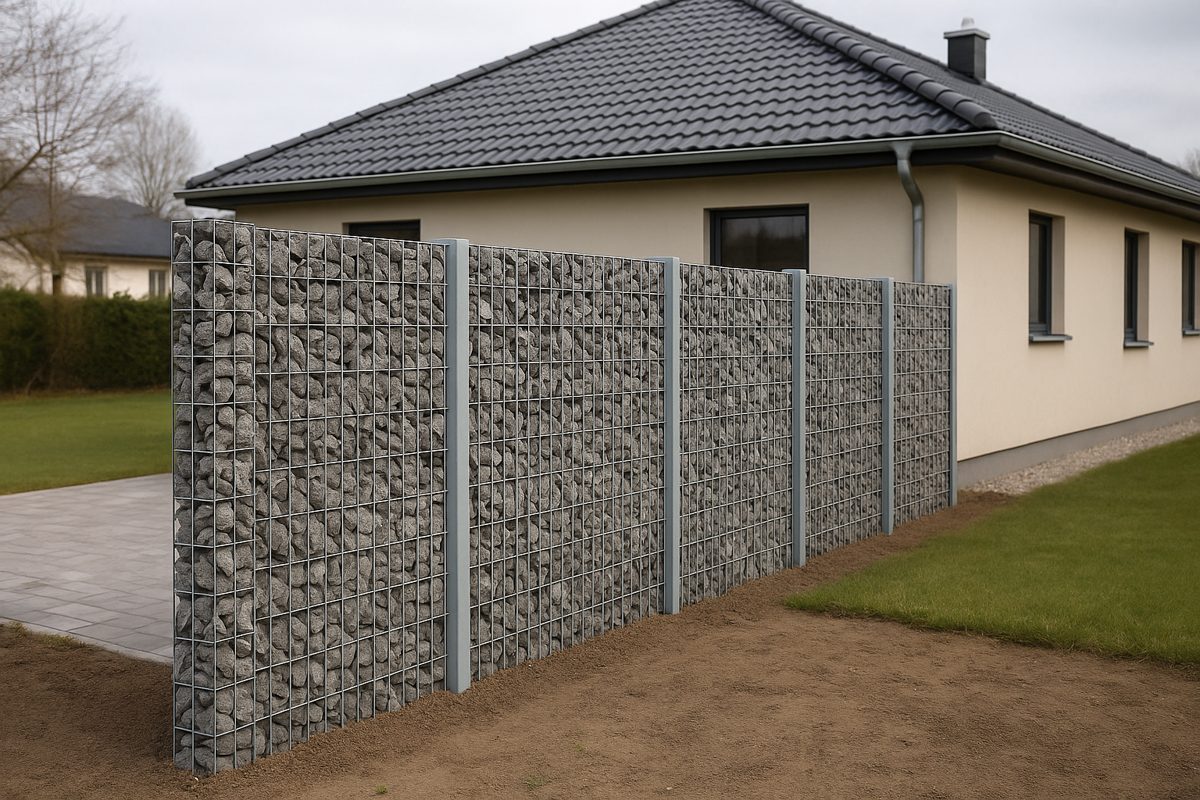
At a glance
- Difficulty
- 3 of 4
- Time
- 2 days for 5 m, plus a week for the concrete
- Tools
- Post-hole digger or auger, string line, carpenter's level, temporary braces, plate compactor, pliers, binders
- Parts
-
- 1 Post footings
- 2 Posts
- 3 Base strip
- 4 Slim baskets
What you need per meter of screen
| Material | Size | Type | Amount |
|---|---|---|---|
| Fill stone | 75–150 mm | Thin baskets with 50 mm mesh; smallest stone at least 1.5 × the mesh | 1.7–1.8 t per m³ |
| or | 100–200 mm | Only in baskets 300 mm or wider with 75 mm mesh | |
| Post footings | 0–4 mm + 8–16 mm | Concrete, as in 4.3 | |
| Base strip | 0–32 mm | Crushed, with fines (9.3) |
Why posts, and why smaller stone?
A narrow wall has little weight to resist tipping, and a solid screen catches the wind like a fence panel. Posts set in concrete take that load. Narrow baskets need posts.
A thin basket must still hold several stones across, or it bulges and shows gaps. Specifications use smaller stone in thinner baskets: 75–150 mm in baskets about 150 mm thick. The mesh must then be smaller too, since every stone has to be bigger than the openings.
Step by step
-
1
Check height rules and set out the posts.
Fences and screens often need a permit above a set height or along a road; check locally. Space the posts to suit the basket lengths and mark each hole.
Post positions marked -
2
Set the posts in concrete (4.3).
Dig, set and brace each post plumb, and fill with concrete as for fence posts. Let it harden before any stone goes near the posts.
Posts braced in wet concrete -
3
Lay a compacted strip between the posts.
A strip of compacted crushed stone (9.3) keeps the basket from sinking between the posts and keeps the bottom level.
The base strip between posts -
4
Fix the baskets to the posts, then fill.
Fix the empty basket to the posts with the clamps or bolts it is made for. Fill as in 9.4: small layers, face stones by hand on both faces, bracing or spacers to keep the faces parallel.
Filling the slim basket between posts
Specifications
| Part | Size | How | Source |
|---|---|---|---|
| Mesh | – | Every stone bigger than the opening; ideally smallest stone ≥ 1.5 × mesh | Kansas DOT, UFGS, Newfoundland and Labrador |
| Stone in thin baskets | 75–150 mm | Baskets about 150 mm thick | Anne Arundel County |
| Layers | – | At least two layers of overlapping stone; three or more per compartment | Newfoundland and Labrador; UFGS |
| Posts and footings | – | As for fence posts (4.3) | See 4.3 |
| Basket width, post spacing | – | Follow the basket maker's guide | Basket maker |
Fill size
75–150 mm is the range Anne Arundel County gives for baskets about 150 mm thick. With 50 mm mesh, the 1.5 × rule (Newfoundland and Labrador) also gives 75 mm as the smallest stone. Mesh sizes for slim garden baskets vary by maker; measure yours.
Posts
Treat the posts as fence posts carrying a heavy panel, and set them as in 4.3.
Sources
- US Department of Defense, UFGS 31 36 00 Gabions: rock 100–200 mm for gabions 500 mm and taller, large enough not to pass the mesh; at most 5 % oversize or undersize, undersize only inside, never on the face; room for three or more layers of rock per compartment; hard, angular to round, durable rock that does not break down in water or weather, with freeze-thaw testing; at most 5 % dirt, sand, clay and fines; 300 mm lifts, no cell more than 300 mm higher than its neighbour; stiffeners at ⅓ and ⅔ of the height; hand-placed visible faces; drop height at most 0.9–1.2 m; overfill 25–50 mm; no foundation work on frozen ground
- Kansas DOT Standard Specifications §1711, Gabions: mesh openings smaller than the gabion rock
- Newfoundland and Labrador Transportation and Infrastructure, Specification 601 Gabions: the least dimension of every stone at least 1.5 × the mesh size; the greatest dimension at most 300 mm; at least two layers of overlapping stone; clean, hard and durable stone; exposed stones hand-picked to keep voids small
- Anne Arundel County (Maryland), Section 02294 Gabions: stone by basket thickness: 150 mm baskets 75–150 mm, 230–450 mm baskets 100–175 mm, 900 mm baskets 100–300 mm; mesh opening at most 100 mm; hard, angular, weather-resistant stone; at least two courses; drop height at most 0.9 m; subgrade smooth and firm
- FHWA Federal Lands, standard drawing W253-3: filled gabions weigh 105 lb/ft³ (17.6 kN/m³, about 1.7 t/m³)
- FHWA Federal Lands, standard drawing E253-01 Gabion retaining wall: rock-filled gabions weigh 110 lb/ft³ (about 1.75 t/m³); front face battered 1:12; underdrain at the back with outlets
Amounts: stone at 1.7–1.8 t per m³ of basket (FHWA design weight of filled gabions). Multiply the basket length × width × height for your baskets.
GLAREUM.NET · Aggregate Handbook