7.5 Reinforced grass parking
Plastic or concrete grids filled with a sandy soil mix and grass. A green surface you can park on now and then, for overflow, a second car or a turning area.
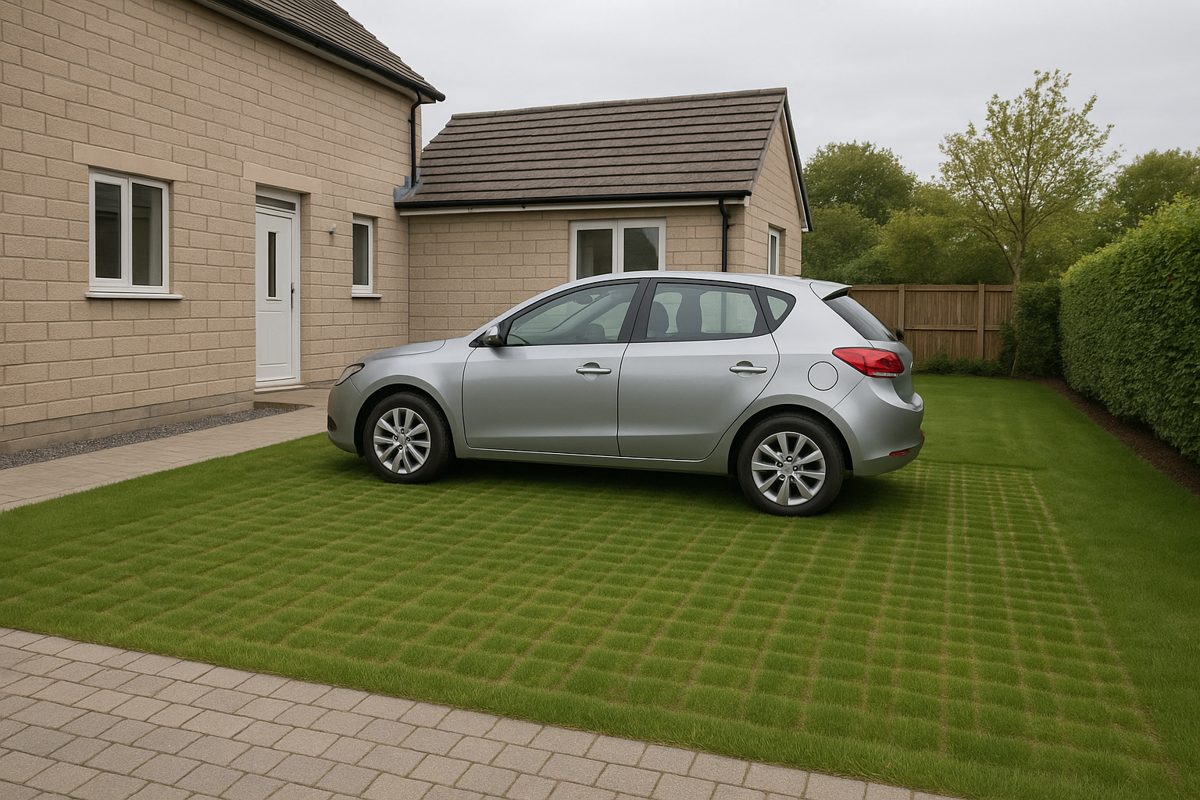
At a glance
- Difficulty
- 3 of 4
- Time
- 2–3 days for 30 m², then at least a month before parking
- Tools
- Spade or mini excavator, wheelbarrow, rake, plate compactor, screed rails and board, string line, saw for cutting grid panels, stiff broom, hose with a sprinkler
- Parts
-
- 1 Geotextile (if needed)
- 2 Base
- 3 Bedding
- 4 Grid and rootzone mix
- 5 Grass
What you need per m²
| Material | Size | Type | Amount |
|---|---|---|---|
| Base | 4–20 mm | Washed, crushed, no fines, 150 mm (6.2) | 230 kg |
| Bedding sand | 0–4 mm | Washed, coarse, 25 mm | 40 kg |
| Rootzone mix | 0–4 mm sand + topsoil | About 60 % sand, 40 % screened topsoil. Example: 40 mm deep grid | about 0.035 m³ |
| Grass | – | Seed, or sod cut thin. Hard-wearing, low-growing, deep-rooted | Seed rate on the pack |
| Grid panels | – | Plastic or concrete grass grid for vehicle use | 1 m² + cuts |
| Geotextile | – | Non-woven, only on soft or clay soil | 1 m² + laps |
Grass or gravel?
For parking now and then: visitors, a trailer, a turning bay, overflow. A car parked on the same spot day after day shades the grass and it dies. Grass also needs mowing and some watering.
For a car that stands there every day. Build the same grid with angular gravel in the cells instead (7.4). You can mix the two: gravel where the car stands, grass around it.
Step by step
-
1
Remove the sod and dig out.
Dig out base + 25 mm bedding + the grid depth, down to firm soil. Keep the area under 5 % slope. Save good topsoil for the rootzone mix.
Dug-out bay, topsoil heaped aside -
2
Lay a geotextile on soft or clay soil, then build the base.
Spread 150 mm of 4–20 mm washed, crushed stone in layers of 100–150 mm and compact each one (6.2). The grass roots can reach the water stored in it.
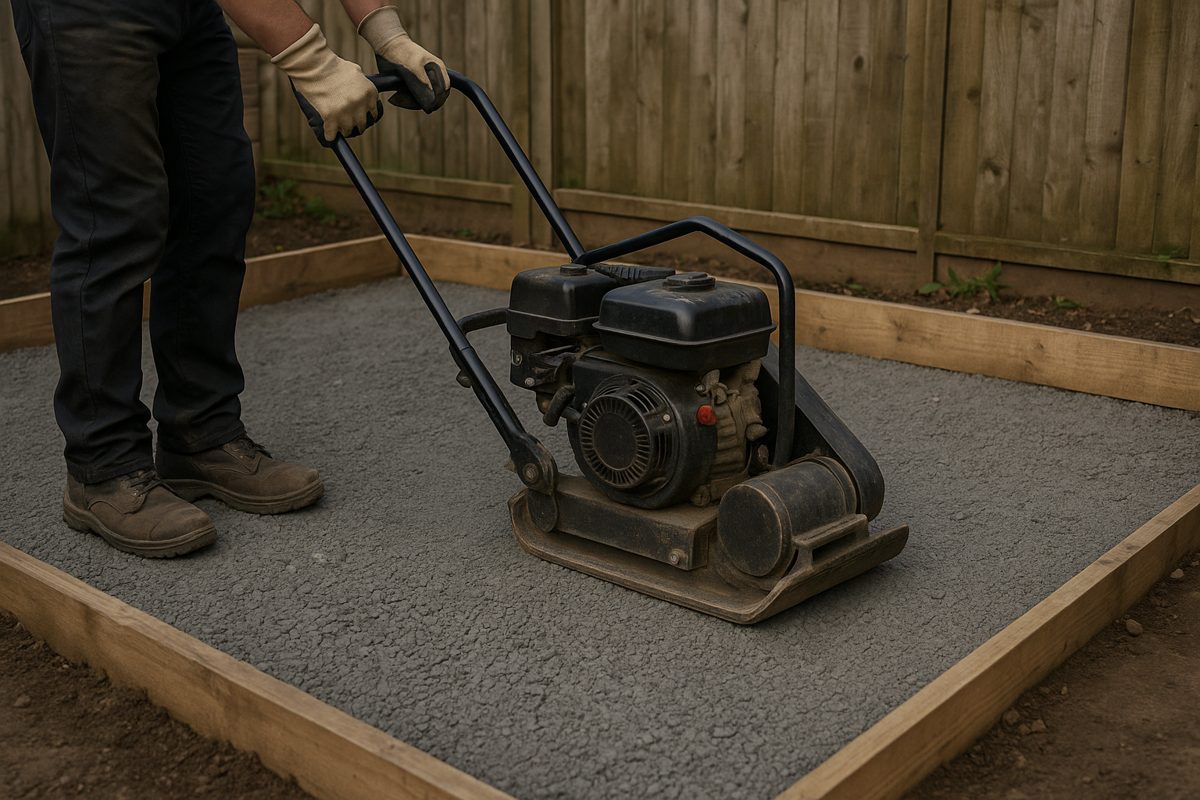
Compacting the base Illustration -
3
Screed and compact the bedding sand.
Spread about 25 mm of coarse sand, screed it level and compact it. Set the edges now if the grid needs them (7.8).
Screeding the sand -
4
Lay the grid panels.
Join the panels and cut them to fit. They must sit flat and not rock. Lay plastic grids and concrete grid blocks as their instructions say.
Grid panels on the sand bed -
5
Fill the cells with the rootzone mix and water it in.
Mix about 60 % coarse sand with 40 % screened topsoil. Brush it into the cells, tamp it down and water it well. Top up so it ends 3–6 mm below the top of the grid.
Filled cells, grid edges showing -
6
Sow seed or lay thin sod.
Seed: sow over the filled cells and rake it in lightly. Sod: lay it over the grid, water it and press it down into the cells. Choose a hard-wearing, low-growing grass with deep roots.
Sowing seed over the grid -
7
Keep cars off for at least a month.
Water the new grass while it roots. Park on it only when the grass is well established.
Area roped off while the grass roots -
8
Look after it like a lawn.
Mow 1–2 times a month in the growing season and collect the clippings. In dry spells water deeply and seldom, not a little every day. Reseed bare spots. Do not use a hollow-tine aerator, and set a snow blade about 25 mm high.
Mowing the grassed bay
Specifications
| Part | Sieve size | Thickness | How |
|---|---|---|---|
| 1 Geotextile | – | – | On soft or clay soil only. |
| 2 Base | 4–20 mm | 150 mm | Compacted in layers of 100–150 mm. |
| 3 Bedding | 0–4 mm | about 25 mm | Coarse sand, screeded and compacted. |
| 4 Rootzone | sand + topsoil | grid depth | About 60 : 40 sand to soil. Ends 3–6 mm below the grid top. |
| 5 Grass | – | – | Seed or sod. No traffic for at least a month. |
Base and bedding
A US state manual gives 75–150 mm of clean 19 mm gravel, compacted, with a 25 mm sand layer on top, under modular grass grids. UK government guidance gives about 150 mm of subbase for a drive. This page uses 150 mm, as in 3.2 and 6.2.
Rootzone mix
A New Hampshire watershed sheet asks for 60 : 40 sand to soil, or 70 : 30 sand to compost, in grassed grids. Singapore sod research found that sand-rich soils resist compaction from traffic and that sod in plastic grids did best on the sandiest mix tested. Sandy mixes hold less water and food, so they need more watering and feeding.
Grid height
At least 3–6 mm of the grid must stand above the soil to carry the wheels. If the soil is level with the top, tires crush the grass crowns.
How much traffic
UK government guidance: not suitable where cars stand for long periods, as the grass may die. US state manuals: plastic grass grids are not for regularly used parking or roads, but suit overflow parking and emergency access; overuse kills the grass. A Rhode Island fact sheet says grass is not suited to all-day, everyday parking because it gets too little light.
Sources
- UK government, Guidance on the permeable surfacing of front gardens: plastic or concrete reinforcement lets cars drive on grass without ruts; low-growing grass needing little mowing; may need mowing; not suitable where vehicles are parked continuously for long periods, as the grass may die; about 150 mm of sub-base over a geotextile; drives steeper than 1 in 20 may not suit
- Connecticut DEEP, 2004 Stormwater Quality Manual, Permeable pavement (11-S6): 75–150 mm (3–6 in) of 19 mm (¾ in) clean gravel compacted to about 95 % Standard Proctor; 25 mm (1 in) sand layer, compacted; soil tamped into the cells and watered; turf laid over, watered and pressed into the cells; at least 3–6 mm (⅛–¼ in) of the paver above the soil; traffic kept off at least a month; mow, irrigate and fertilise like other turf; inspect yearly
- North Carolina DEQ, Stormwater Design Manual C-5, Permeable pavement: plastic turf grids not for regularly used parking or roads, suited to overflow parking and emergency access; must be mowed, sometimes fertilised and watered; overuse can kill the turf; concrete grids not recommended for regularly used parking; snow blade about 25 mm (1 in) higher
- Rhode Island DEM, RI Stormwater Solutions fact sheet: grid pavers: grass unsuitable for everyday, all-day parking because of too little sunlight; gravel better for frequent use; deep-rooted grass such as tall fescue that reaches the base course; water with infrequent soakings; do not aerate, it damages the pavers; reseed bare spots
- NC Cooperative Extension AG-588-23, Maintaining permeable pavements: plastic grids filled with gravel or topsoil and turfgrass; mowing 1–2 times a month in high season; catch clippings so they do not clog the surface
- Wentworth Watershed Restoration and Protection Strategies (Town of Wolfeboro, NH), Stormwater friendly driveways: plastic grid systems: planting mix for grassed grids 60 : 40 concrete sand to soil, or 70 : 30 concrete sand to compost; maximum slope 5 %; mowing needed; careless use of deicers kills grass
- National Parks Board Singapore (CUGE), Research Technical Note RTN 05-2012, Selecting right soil type for turf: sandy soils resist compaction from traffic but need more fertiliser and irrigation; 75/25 and 50/50 sand-to-soil mixes
- Chin and Ow (National Parks Board Singapore), Performance of turf on a turf-paver complex under simulated traffic, ASHS 2015: both grasses in plastic turf pavers performed best on the mix with the most sand
- Sustainable Technologies Evaluation Program (TRCA), Permeable pavements: base layers of 100–150 mm; geotextile commonly used on low-strength soils (CBR under 4)
- FHWA-HRT-15-034, open-graded aggregates: minimum (loose) unit weight of No. 57 stone 95.4 lb/ft³ (1.53 t/m³)
- FHWA-RD-97-148, Granular base: natural aggregates weigh about 2.0–2.3 t/m³
- NPTEL (Indian Institutes of Technology), soil mechanics worked examples: dry sand about 1,600 kg/m³
Amounts: base 0.15 m × 1.53 t/m³ ≈ 230 kg; bedding sand 0.025 m × 1.6 t/m³ = 40 kg; rootzone for an example 40 mm deep grid with about 90 % open cells ≈ 0.035 m³. Check the depth and open area of your grid. No waste is included; order a little extra. ¾ in clean gravel is shown as 4–20 mm, and the 3–6 mm grid height is ⅛–¼ in. The 60 : 40 mix comes from one watershed sheet; the Singapore studies support "more sand takes traffic better", not an exact ratio.
GLAREUM.NET · Aggregate Handbook